

Why Startups Need a Brand Strategy First
Brand strategy is defined as the foundational business decision that determines who a startup serves, what it stands for, and how it differs from every other option in the market. Without it, startups spend money on tactics that point in different directions, confuse customers, and stall growth before it begins. The reason why startups need a brand strategy first is simple: every other decision, from product messaging to hiring to investor pitches, depends on it. 95% of industry-labeled brand strategies lack true market direction. That statistic reveals how widespread the confusion between real strategy and tactical activity actually is.
Why startups need a brand strategy first, not last
Brand strategy is not a logo, a tagline, or a color palette. It is the answer to three questions every startup must resolve before spending a dollar on marketing: who is this for, what problem does it solve, and why should anyone choose it over the alternative. When those answers are clear and consistent, every downstream decision gets faster and cheaper.
The industry term for this foundational work is “brand positioning.” It sits at the intersection of business strategy and market communication. Startups that treat positioning as a marketing task rather than a leadership responsibility pay for that mistake in wasted ad spend, confused sales teams, and investors who cannot repeat the pitch back to you.

Brand equity compounds over time. A startup that builds coherent positioning from day one earns trust faster and grows more sustainably than one that retrofits its identity after hitting a growth wall. The smartest founders treat brand clarity as a growth lever, not a branding exercise.
What happens when startups skip brand strategy?
Approximately 50 million new companies launch every year, and poor brand strategy ranks among the leading causes of early failure. Inconsistent messaging and weak positioning create market confusion that no amount of paid advertising can fix.
Skipping brand strategy produces predictable failure patterns:
- Inconsistent messaging across channels signals to customers that the company does not know what it is, which destroys trust before a relationship begins.
- Weak positioning leaves the startup competing on price by default, because it has given customers no other reason to choose it.
- Wasted resources pile up when teams run campaigns, redesign websites, and hire content writers without a shared direction to guide them.
- Investor confusion follows when founders cannot explain their differentiation in two sentences, because the differentiation was never defined.
- Internal contradictions emerge when product, sales, and marketing teams each operate from a different understanding of who the customer is.
Each of these problems is a symptom of the same root cause: the startup treated brand as decoration rather than direction.
Pro Tip: Before your next marketing spend, write one sentence that answers: who is your customer, what do you do for them, and why you specifically. If three people on your team write different answers, your brand strategy work starts there.
Is brand strategy really a leadership responsibility?
Brand strategy is fundamentally business strategy. When leadership delegates it entirely to a marketing team or an agency, the result is a brand that reflects marketing preferences rather than business priorities. That misalignment drives up costs and weakens growth potential.
Leadership ownership of brand strategy produces measurable organizational benefits. Sales teams close faster when they can articulate a clear, consistent value proposition. Hiring becomes easier when the company’s identity attracts candidates who already believe in its mission. Marketing costs drop when every campaign draws from the same positioning rather than reinventing the message each quarter.
“A brand is not what you say it is. It is what your customers, employees, and investors believe it to be. Leadership that does not actively define and maintain that belief leaves the market to define it instead.”
Internal alignment on brand clarity also prevents contradictory business goals. When the product team, the sales team, and the executive team all operate from the same positioning, decisions across teams stay consistent. That consistency is a competitive advantage that no single campaign can manufacture.
The practical implication for startups is direct: brand strategy belongs on the leadership agenda, not the marketing calendar. It requires the same attention as financial planning and product roadmapping, because it shapes both.
Does “start with why” actually work for early-stage startups?
The “start with why” framework, popularized by Simon Sinek, argues that purpose-driven communication builds deeper loyalty. For established brands with proven products, that logic holds. For early-stage startups, it creates a specific and costly problem: purpose-driven paralysis.
Customers who have never heard of your startup do not yet care about your philosophy. They care about whether your product solves their problem better than what they already use. Leading with abstract purpose before establishing clear functional benefits confuses customers and investors alike.
The correct sequence for early-stage brand strategy looks like this:
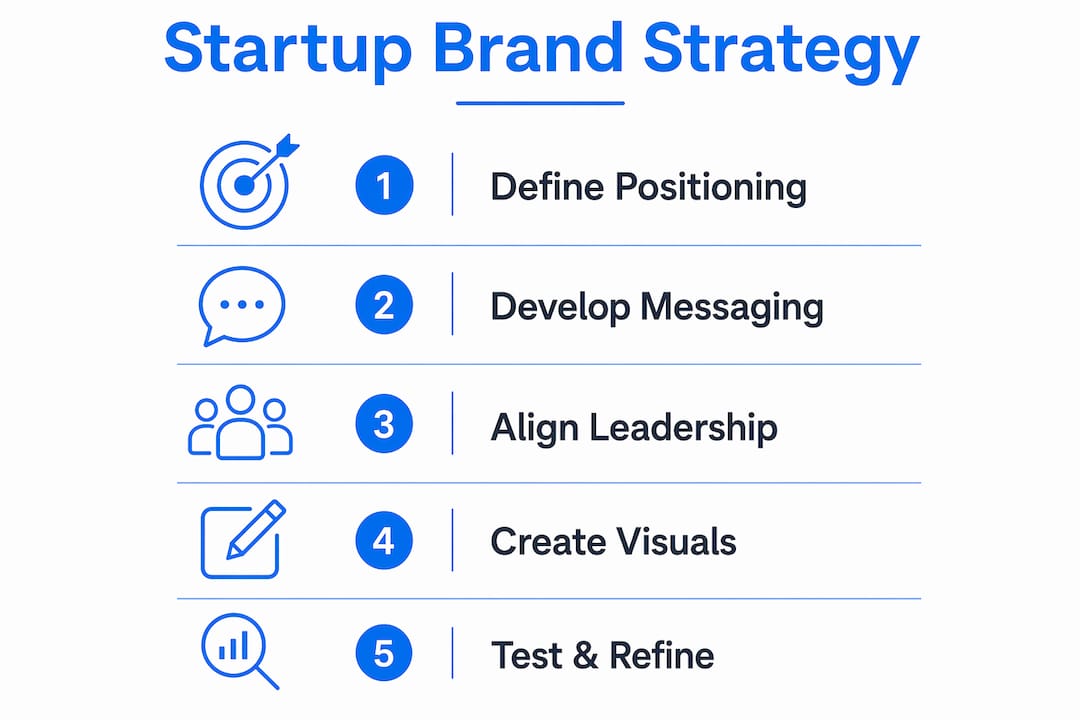
- Define what you do. State the product or service in plain language. Avoid metaphors and mission-speak.
- Name who it is for. Describe the customer with enough specificity that your team could identify one on the street.
- Explain the functional benefit. State the outcome the customer gets, not the values you hold as a company.
- Establish your differentiation. Name the one thing you do differently or better than the next best option.
- Layer in purpose. Once customers understand and trust the product, purpose-driven messaging deepens loyalty rather than creating confusion.
Startups that skip steps 1 through 4 and lead with step 5 often produce messaging that sounds inspiring internally and means nothing externally. The brands that win early markets communicate with brutal clarity about what they do and for whom.
Pro Tip: Test your brand message with five people outside your company. If they cannot explain what you do after reading your homepage, your positioning needs work before your next campaign does.
How do you build a practical brand strategy early?
Effective early-stage brand strategy is concise and built to guide fast, correct decisions. It is not a 60-page brand manual that lives in a shared drive and gets opened twice a year. It is a short set of principles that every team member can apply when making product, marketing, or communication decisions.
A practical startup brand strategy covers four areas:
| Area | What to define |
|---|---|
| Positioning | Who you serve, what you solve, and why you win |
| Verbal identity | The tone, vocabulary, and message hierarchy you use consistently |
| Visual identity | The colors, typography, and design language that signal your positioning |
| Decision filter | A short test any team member can apply to check if a decision fits the brand |
The decision filter is the most underused tool in startup branding. It replaces lengthy approval chains with a shared standard. When a content writer, a sales rep, and a product manager all use the same filter, the brand stays consistent without requiring a brand manager to review every output.
Visual and verbal identity should follow positioning, not precede it. A startup that picks a color palette before defining its positioning often ends up redesigning its visual identity within 18 months because the design no longer fits the market reality. Getting brand positioning right from the start prevents that expensive cycle.
AI-generated content abundance makes authentic, disciplined brand differentiation more valuable, not less. When every competitor can produce polished content at scale, the startups with a clear and consistent human voice stand out. That voice comes from brand strategy, not from content volume.
The startup story you tell to customers, investors, and recruits should draw directly from your brand positioning. When the story is consistent across every channel, trust accumulates faster. When it shifts depending on the audience or the platform, it signals uncertainty and slows growth.
Startups waste resources creating long brand manuals instead of short, usable principles. A one-page brand brief that answers what you are building, who it is for, and why it matters outperforms a 40-page brand book that no one reads. Simplicity is not a shortcut. It is the standard.
Key Takeaways
Brand strategy is the first business decision a startup must make because it determines the direction of every other decision that follows.
| Point | Details |
|---|---|
| Strategy before tactics | Define positioning before spending on marketing, content, or advertising. |
| Leadership must own it | Brand strategy set by marketing alone drives higher costs and weaker alignment. |
| Clarity beats purpose early | Communicate what you do and for whom before leading with philosophical mission. |
| Short principles over long manuals | A one-page brand brief guides daily decisions better than a 60-page brand book. |
| Consistency compounds | Coherent branding from launch builds trust faster and lowers growth costs over time. |
What I’ve learned from watching startups get this wrong
The pattern I see most often is a founder who builds a great product, hires a designer to create a beautiful brand, and then discovers six months later that the brand communicates the wrong thing to the right customer. The redesign costs more than the original build. The delay costs more than the redesign.
Early brand clarity correlates directly with investor confidence. Investors who hear a clear, consistent positioning story in a pitch meeting trust the founder’s judgment more broadly. When the story shifts between meetings, or when the founder cannot state the differentiation without a slide deck, that uncertainty transfers to the investment decision.
The other mistake I see regularly is chasing brand trends. A startup sees a competitor use a bold sans-serif typeface and a muted color palette and copies the aesthetic without copying the underlying positioning. The result looks current but communicates nothing distinctive. Trends are a shortcut that leads to sameness.
Simplicity and consistency outperform complexity at every early stage. A startup that says the same clear thing in the same clear way, across every channel, every week, builds recognition faster than one that produces sophisticated campaigns without a shared foundation. The tailored marketing strategy always starts with brand clarity, not the other way around.
— Eric
How Marvingrowthpartners helps startups build brand-led growth
Startups that get brand strategy right from the start grow faster, spend less on corrective marketing, and attract better customers and investors. The challenge is that most founders are deep in product development when brand decisions need to be made, and the cost of getting it wrong compounds quickly.
Marvingrowthpartners specializes in aligning brand clarity with business execution so that startups do not have to choose between moving fast and building right. The approach connects leadership-owned brand strategy with hands-on growth execution, producing positioning that guides real decisions rather than sitting in a document no one uses. If your startup is ready to build a brand that drives growth rather than just describes it, Marvingrowthpartners delivers the structure and execution to make that happen.
FAQ
What is brand strategy for a startup?
Brand strategy is the foundational set of decisions that defines who a startup serves, what it offers, and how it differs from competitors. It guides every communication, product, and business decision the company makes.
Why do startup brands fail without a clear strategy?
Startups without brand strategy produce inconsistent messaging that confuses customers and weakens positioning. Poor brand clarity is a leading cause of early-stage failure among the approximately 50 million companies that launch each year.
When should a startup build its brand strategy?
Brand strategy should be built before the first marketing campaign, not after. The smartest founders develop brand clarity simultaneously with their product, because positioning shapes how the market perceives every launch decision.
Is brand strategy the same as a logo or visual identity?
No. Visual identity is one output of brand strategy, not the strategy itself. Brand strategy defines positioning, values, and differentiation first. Visual and verbal identity are then designed to express that positioning consistently.
How long should a startup brand strategy document be?
A startup brand strategy works best as a short, usable document, often a single page. Lengthy brand manuals rarely get applied. A concise brand brief that answers what you build, who it is for, and why it matters guides daily decisions far more effectively.
Recommended
- Craft Your Startup Story for Marketing Success – Marvin Growth Partners
- Brand Positioning for SMBs: Your 2026 Growth Guide – Marvin Growth Partners
- The Role of Content Strategy in Brand Building – Marvin Growth Partners
- Build a Custom Marketing Strategy for Your Detroit Business – Marvin Growth Partners