

Brand Positioning for SMBs: Your 2026 Growth Guide
Brand positioning is defined as the strategic act of securing a distinct, defensible place for your SMB in the minds of your target customers. It is the core discipline behind why some small businesses grow through referrals while others compete on price and lose. The role of brand positioning for SMBs goes far beyond a tagline or a logo. Consistent brand presentation across platforms increases annual revenue by 23%, and 81% of consumers say they must trust a brand before making a purchase. Those two numbers explain why positioning is not a luxury reserved for large companies. It is the foundation every SMB needs before spending a dollar on advertising.
Why is brand positioning essential for SMB success?
Brand positioning gives your marketing a fixed point to aim at. Without it, every campaign starts from scratch, every sales conversation goes a different direction, and your message never sticks.
The business benefits are concrete:
- Clarity in messaging. A well-defined position tells your team exactly what to say and what to leave out. That clarity cuts the time spent debating copy, creative direction, and campaign angles.
- Marketing efficiency. A documented brand identity guide allows teams to pre-decide approximately 70% of marketing and creative decisions, reducing operational friction and saving hours every week.
- Attracting the right customers. When your positioning speaks directly to a specific buyer’s problem, the right prospects self-select. You spend less time on bad-fit leads.
- Reduced price competition. Strong brand positioning makes a prospect able to clearly explain what you do and why it matters in one sentence. Buyers who understand your distinct value do not default to comparing prices.
- Referral growth. When customers can articulate your value clearly, they refer others who fit your profile. That is organic growth with zero ad spend.
Pro Tip: Write your positioning in plain language and test it by asking a current customer to repeat it back to you. If they can do it in one sentence, your positioning is working.
A focused SMB can out-position larger competitors anchored to the generic middle of the market, even with a smaller budget. Specificity beats scale when it comes to resonance.
How does brand positioning relate to brand identity and brand strategy?
These three terms get used interchangeably, but they describe different things. Confusing them leads to misaligned execution.

Positioning is the strategic claim. It defines who you serve, what you do better than alternatives, and why that matters to your buyer. It answers the “versus” question: where do you stand relative to everyone else in the market?
Brand identity is the expression system. It covers the visual, verbal, and experiential elements that communicate your positioning to the world.
| Element | What it covers | Primary function |
|---|---|---|
| Brand positioning | Target audience, differentiation, value claim | Strategic direction |
| Brand identity | Logo, color, typography, tone of voice | Visual and verbal expression |
| Brand guidelines | Rules for applying identity consistently | Operational consistency |
| Brand strategy | Long-term plan connecting positioning to growth | Execution roadmap |
Branding refers to the visual and verbal elements expressing who you are, while positioning is your place relative to competitors. One without the other creates problems. A company with a polished logo but no clear positioning looks professional but says nothing meaningful. A company with sharp positioning but inconsistent visuals confuses the people it is trying to attract.
Most SMBs confuse having a logo with having a brand. Brand identity includes visual, verbal, emotional, and experiential elements consistent across every touchpoint. A strategic foundation covering purpose, values, positioning, and personality must come before any visual design work begins.
Brand guidelines are the operational bridge between strategy and execution. They define color usage, tone of voice, logo spacing, and communication style upfront. That upfront work is what allows your marketing to align with business goals without constant back-and-forth between teams.
What are effective strategies for SMBs to position their brand?
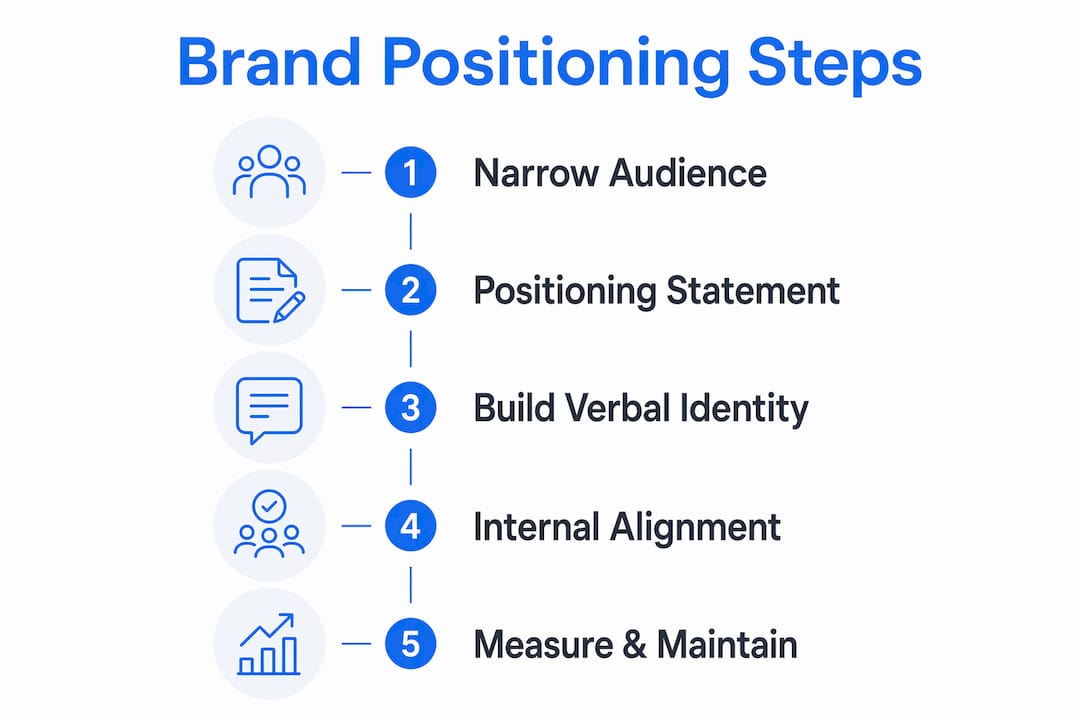
Positioning strategy for SMBs follows a clear sequence. Skipping steps produces weak results.
Step 1: Narrow your target audience
The most common mistake SMBs make is trying to appeal to everyone. Positioning to a narrow target audience results in stronger engagement and easier referral-based growth. Broad, generic positioning fails to resonate strongly with any buyer. Pick a specific segment and own it completely.
Step 2: Write a positioning statement
A positioning statement is an internal document, not a headline. It answers four questions: Who is your ideal customer? What category do you operate in? What is your primary benefit? What proof supports that claim? Keep it to two or three sentences. Write it for your team, not for your homepage.
Step 3: Build a messaging hierarchy
A brand positioning hierarchy organizes communications from the top-level positioning statement through core messaging pillars to audience-specific and channel-specific talk tracks. This structure prevents inconsistent messaging as your SMB grows. Without it, your marketing team, sales team, and website tell three different stories.
- Positioning statement. The internal anchor. One clear claim about who you serve and why you win.
- Messaging pillars. Three to four themes that support the positioning claim with evidence and context.
- Audience-specific messages. Variations of the pillars tailored to different buyer roles or segments.
- Talk tracks. Channel-ready language for sales calls, email, social media, and ads.
Step 4: Build verbal identity for digital visibility
Verbal identity goes beyond a tagline. It includes the specific words, phrases, and tone your brand uses consistently. Branding is essential for AI visibility and voice search. Verbal identity beyond logos ensures digital recognition and entity association in AI-powered search results. SMBs that define their verbal identity now will have a structural advantage as AI-driven discovery grows.
Pro Tip: Create a short “brand vocabulary” list of 10 to 15 words and phrases your brand owns. Share it with every person who writes or speaks on behalf of your company.
Step 5: Align internally before going external
Positioning is fundamentally an internal alignment tool, not homepage marketing copy. Your leadership, sales, and marketing teams must agree on the positioning before it reaches customers. Internal misalignment produces external confusion. Run a positioning workshop with your core team before launching any campaign built on the new position.
For a full picture of how positioning fits into your SMB marketing strategy, the approach you choose must match your growth stage and resources.
How can SMBs measure and maintain brand positioning effectiveness?
Positioning is not a one-time decision. Markets shift, competitors move, and customer needs evolve. SMBs that treat positioning as a fixed asset lose ground to those who treat it as a living system.
Track these indicators regularly:
- Brand awareness. Survey new customers on how they found you and what they understood about your offer before contacting you. A rising number of pre-qualified inbound leads signals strong positioning.
- Customer preference. Ask customers why they chose you over alternatives. If their answers match your positioning claim, the message is landing. If they cite price, your positioning is not doing its job.
- Marketing ROI by channel. Channels where your positioning resonates will show higher conversion rates. Channels where it does not will show high traffic and low conversion.
- Brand recall. Test whether prospects can describe your business accurately after one touchpoint. Consumers typically require 5 to 7 brand impressions to remember a business. Tracking recall helps you know whether your frequency and consistency are sufficient.
- Sales cycle length. Well-positioned brands attract buyers who already understand the value. A shorter average sales cycle is a direct signal that positioning is working.
Update your brand guidelines and messaging hierarchy whenever your product, audience, or competitive environment changes significantly. Assign one person ownership of the positioning document so updates happen deliberately, not accidentally. Consistency across platforms is not just a creative preference. It is the mechanism by which trust accumulates over time. Your social media brand presence must reflect the same positioning your sales team uses in every conversation.
Key takeaways
Brand positioning is the single highest-leverage investment an SMB can make because it determines whether every other marketing dollar works or gets wasted.
| Point | Details |
|---|---|
| Positioning drives revenue | Consistent brand presentation increases annual revenue by 23% through trust and recognition. |
| Narrow focus wins | Targeting a specific audience produces stronger engagement and referral growth than broad messaging. |
| Identity follows positioning | Visual and verbal brand elements must express a defined position, not precede it. |
| Messaging hierarchy prevents drift | Organizing communications from positioning statement to talk tracks keeps teams aligned as you grow. |
| Measure to maintain | Track brand recall, sales cycle length, and customer preference to confirm positioning is working. |
The trap most SMBs fall into with brand positioning
Here is what I see consistently when working with SMB owners on positioning: they write about themselves instead of their buyers. The positioning statement becomes a list of company achievements, process descriptions, and internal pride points. None of that is what a buyer needs to hear.
Effective positioning focuses entirely on the buyer’s problem, their alternatives, and why your approach fits their situation better than anything else available. The moment you shift from “we are a team of experienced professionals” to “you are trying to solve X and here is why we are the right fit,” everything changes. Prospects lean in. Sales conversations get shorter. Referrals get more specific.
The second trap is fear of narrowing. I have heard it dozens of times: “If we get too specific, we will miss opportunities.” The opposite is true. Specificity increases engagement and referral potential. A focused SMB that owns a clear niche builds a reputation that a generalist never can. The right customers pre-qualify themselves because they recognize immediately that your brand fits their needs better than any alternative.
Positioning also works as an internal tool before it works externally. When your team agrees on the positioning, they make faster decisions, write better copy, and have more consistent sales conversations. That internal clarity is worth as much as any external campaign.
— Eric
How Marvingrowthpartners helps SMBs build positioning that drives growth

Marvingrowthpartners works with SMBs that need more than a marketing plan. The firm combines executive-level positioning strategy with hands-on execution, so your brand message and your growth system move together. That means your positioning statement does not sit in a document. It shows up in your sales process, your website, your content, and your customer conversations.
If your marketing feels scattered or your message is not landing with the right buyers, the issue is almost always positioning. Marvingrowthpartners builds the messaging hierarchy, aligns your team, and connects your brand position to measurable growth outcomes. See how the approach works and whether it fits where your business is right now.
FAQ
What is brand positioning for an SMB?
Brand positioning is the process of defining a distinct, meaningful place your business occupies in the minds of your target customers. It clarifies who you serve, what you do better than alternatives, and why that matters to your buyer.
How does brand positioning differ from brand identity?
Positioning is the strategic claim about where you stand relative to competitors. Brand identity is the visual and verbal system that expresses that claim through logos, color, tone of voice, and other touchpoints.
Why does narrowing your audience improve positioning?
Positioning to a narrow target audience produces stronger engagement and easier referral growth. Broad positioning fails to resonate strongly with any single buyer, making your message forgettable.
How often should SMBs update their brand positioning?
Update your positioning whenever your product, target audience, or competitive environment changes significantly. Assign one person ownership of the positioning document to keep updates deliberate and consistent.
What is a messaging hierarchy and why does an SMB need one?
A messaging hierarchy organizes your communications from a top-level positioning statement through core pillars to audience-specific talk tracks. Without it, your marketing, sales, and website teams tell inconsistent stories that confuse prospects.
Recommended
- Marketing Strategy Types for SMBs: 2026 Growth Guide – Marvin Growth Partners
- Build a Custom Marketing Strategy for Your SMB in 2026 – Marvin Growth Partners
- The Role of Social Media in Brand Presence for SMBs – Marvin Growth Partners
- Why Content Marketing Drives SMB Growth in 2026 – Marvin Growth Partners