

Tailored Marketing Strategy: What It Is and How It Works
A tailored marketing strategy is the deliberate customization of marketing plans and messages to meet the unique needs and behaviors of specific customer segments. Unlike broad campaigns that treat all buyers the same, this approach uses micro-segmentation, real-time behavioral data, and persona-driven messaging to deliver the right content at the right moment. The result is stronger customer engagement, higher conversion rates, and measurable business growth. If you are a marketing professional or business owner asking what is tailored marketing strategy and how to build one, this guide covers the full picture.
What is tailored marketing strategy and how does it differ from traditional marketing?
Traditional marketing relies on broad demographic segments: age, location, income. A tailored approach goes further by breaking audiences into micro-segments that typically represent 1–5% of the total audience. That level of specificity produces messaging that feels personal rather than generic.
The structural difference shows up in how data is used. Traditional campaigns run on static demographic profiles and fixed calendar schedules. A personalized marketing approach runs on live behavioral signals: what a customer browsed, what they abandoned in a cart, how long they spent on a pricing page. Behavior-based triggers outperform static campaign schedules because they capture customer intent in the moment rather than guessing at it in advance.
The impact on conversion is direct. When a message matches what a customer is actively thinking about, the chance of action increases. When it does not, the message is noise. That gap between noise and relevance is exactly where tailored marketing creates its advantage.

| Attribute | Traditional marketing | Tailored marketing |
|---|---|---|
| Audience targeting | Broad demographic segments | Micro-segments (1–5% of audience) |
| Data source | Static profiles, census data | Real-time behavioral and transactional data |
| Message timing | Fixed calendar schedules | Behavior-triggered, intent-based |
| Personalization depth | Generic or lightly segmented | Persona-specific, journey-stage aligned |
| Primary KPI | Reach and impressions | Engagement rate and conversion |
Key components of an effective tailored marketing strategy
A marketing strategy connects business objectives with audience targeting, channel selection, and measurement. When that strategy is tailored, each of those elements gets customized to a specific segment rather than applied uniformly.
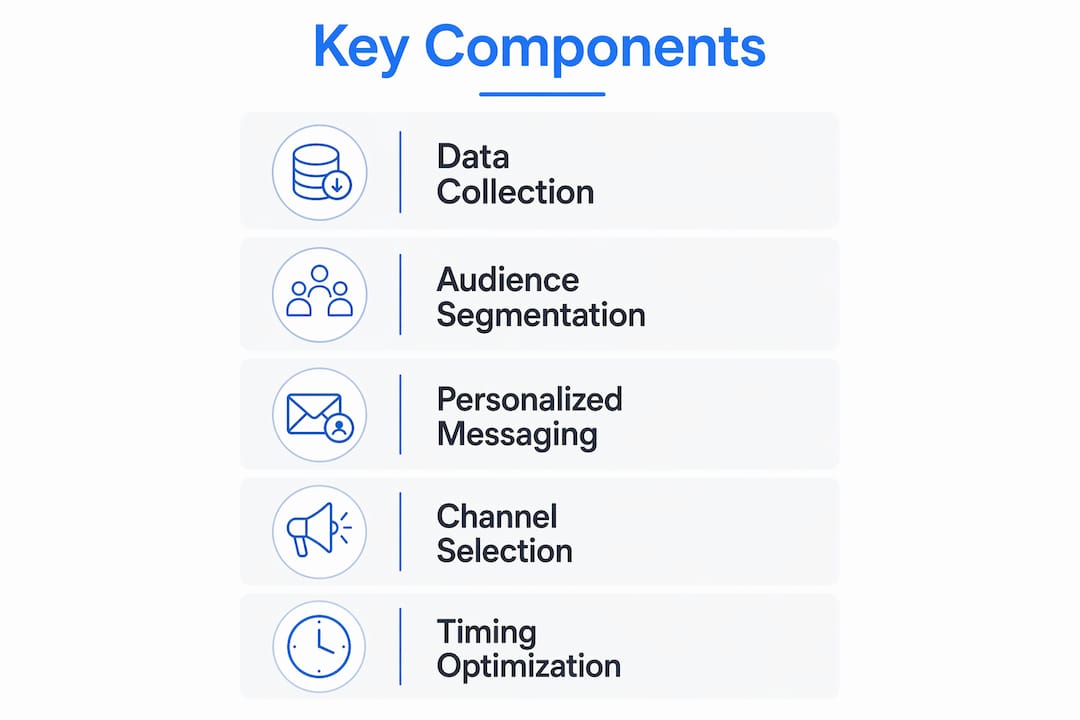
The core components are:
- Audience micro-segmentation and persona development. Segment your audience beyond demographics. Use purchase history, support interactions, and browsing behavior to build personas that reflect real customer motivations. Persona-focused messaging increases relevance and loyalty because it speaks to what the customer actually values.
- Data integration across touchpoints. Sales data, support tickets, and marketing analytics must feed into one unified view. Fragmented data causes fragmented experiences. When a customer contacts support and then receives a marketing email that ignores that interaction, trust erodes.
- Real-time personalization and behavioral triggers. Set up triggers based on live actions: product page visits, cart abandonment, repeat logins. Real-time triggers dramatically improve relevance over scheduled, calendar-based marketing because they respond to what the customer is doing now.
- KPI measurement focused on engagement and ROI. Track open rates, click-through rates, conversion rates, and customer lifetime value by segment. Aggregate metrics hide what is working for specific groups.
- Marketing technology that supports automation. Tools like CRM platforms, marketing automation software, and customer data platforms (CDPs) make it possible to execute personalization at scale without manual effort for every message.
Pro Tip: Build your persona library from actual customer interviews, not just analytics. Numbers tell you what customers do. Conversations tell you why. The “why” is where the best messaging comes from.
Common challenges in implementing customized marketing tactics
The biggest mistake marketers make is confusing strategy with tactics. Strategy defines the “why” and aligns marketing with business goals and audience needs. Tactics are the “how” and “when.” Jumping straight to tactics without a clear strategy produces activity without direction.
A second major pitfall is over-personalization. Sending too many personalized messages too frequently causes customer fatigue. Excessive personalization can cause consumers to tune out entirely. The Fatigue Index is an advanced metric that tracks message frequency per customer and flags when cadence needs to pull back. Marketers who monitor it proactively protect engagement rates instead of repairing them after the damage is done.
Data silos create a third problem. When marketing, sales, and support each hold separate customer data, the customer receives inconsistent experiences. A prospect who just filed a support complaint should not receive a promotional upsell email the same afternoon. Integrated personalization across marketing, support, and renewals builds trust and retention. Siloed data destroys both.
Mistiming communication is equally damaging. Sending a re-engagement email to a customer who just made a purchase, or a discount offer to someone who is actively comparing options, signals that you are not paying attention. Timing must align with where the customer is in their decision process, not where your campaign calendar says they should be.
Pro Tip: Set a hard cap on the number of marketing touches per customer per week. Three to four touchpoints across all channels is a reasonable starting point. Adjust based on your Fatigue Index data, not on gut feel.
How to create a tailored marketing plan step by step
Building a custom marketing strategy requires a clear sequence. Skipping steps produces gaps that show up as inconsistent customer experiences.
- Conduct detailed customer segmentation. Pull data from your CRM, e-commerce platform, and support system. Group customers by behavior patterns, purchase frequency, and product category interest. Avoid segmenting only by age or location.
- Build customer personas. Create three to five detailed personas that represent your highest-value segments. Each persona should include goals, pain points, preferred channels, and typical objections. Use real customer language from interviews and reviews.
- Map messaging to customer journey stages. A customer who just discovered your brand needs different content than one who has purchased twice. Align your messages to awareness, consideration, and decision stages for each persona.
- Select channels based on where each segment is active. Channel selection and timing are critical for personalized marketing success. Email works for re-engagement. Social retargeting works for awareness. SMS works for time-sensitive offers to high-intent buyers.
- Set up behavioral triggers. Configure your marketing automation platform to fire messages based on live actions: a cart abandoned after 30 minutes, a pricing page visited twice in one week, a subscription renewal date approaching.
- Track and optimize by segment. Review performance data weekly by persona and segment. Kill what is not converting. Scale what is. Use A/B testing on subject lines, send times, and offer types to continuously improve.
The table below shows how messaging and channel choices shift across journey stages for a B2B software company.
| Journey stage | Customer mindset | Channel | Message focus |
|---|---|---|---|
| Awareness | Exploring options | LinkedIn, blog content | Problem identification, thought leadership |
| Consideration | Comparing solutions | Email, webinars | Feature comparisons, case studies |
| Decision | Ready to buy | Email, sales outreach | Pricing, demos, risk reduction |
| Retention | Post-purchase | Email, in-app | Onboarding, upsell, loyalty rewards |
Aligning marketing with business goals at each stage keeps the strategy coherent rather than a collection of disconnected campaigns.
Key Takeaways
A tailored marketing strategy outperforms traditional marketing because it matches specific messages to specific customer behaviors at the right moment, not the right calendar date.
| Point | Details |
|---|---|
| Micro-segmentation drives precision | Break audiences into segments of 1–5% of total audience for higher engagement and conversion. |
| Behavioral triggers beat schedules | Real-time triggers based on live customer actions outperform fixed campaign calendars. |
| Data integration is non-negotiable | Unified data across sales, marketing, and support prevents fragmented customer experiences. |
| Fatigue Index prevents burnout | Monitor message frequency per customer to protect engagement before it drops. |
| Strategy must precede tactics | Define the “why” and audience alignment before choosing channels or creative formats. |
Why most tailored marketing fails before it starts
The shift from campaign-driven to behavior-driven marketing is real, and it is accelerating. What I have seen working with growing businesses is that most teams understand personalization in theory but execute it as a cosmetic layer on top of the same old broadcast approach. They add a first name to an email subject line and call it personalized. That is not a tailored marketing strategy. That is a mail merge.
The businesses that get this right start with the customer’s current behavior, not with what they want to say. Behavioral architecture, meaning starting personalization from live consumer actions, is what separates effective programs from expensive ones. The companies I have seen generate the strongest ROI are the ones that built triggers first and creative second.
The other thing I will say plainly: personalization without data integration is theater. If your marketing team does not have visibility into what your support team is handling, you will keep sending tone-deaf messages at the worst possible moments. Cross-department data sharing is not a technology problem. It is a leadership decision. Make it.
Real-time personalization is now table stakes. The differentiator in 2026 is whether your message arrives at the exact moment the customer is ready to act, not just whether it mentions their name. Build for timing. The data-driven decisions that come from behavioral data will always outperform the ones made in a quarterly planning meeting.
— Eric
How Marvingrowthpartners helps you build a strategy that actually works
Marvingrowthpartners works with growing businesses that need executive-level marketing thinking without the cost of a full-time hire. The team builds tailored growth systems grounded in real customer data, not recycled playbooks.
If your marketing feels disconnected from your actual business goals, or if your personalization efforts are producing activity but not revenue, Marvingrowthpartners can close that gap. The approach combines growth strategy consulting with hands-on execution, covering segmentation, messaging architecture, channel selection, and performance tracking. Businesses that work with Marvingrowthpartners get a clear plan, measurable milestones, and a team that stays accountable to results. Learn more about the fractional marketing leadership model to see if it fits your growth stage.
FAQ
What is a tailored marketing strategy in simple terms?
A tailored marketing strategy is the practice of customizing your marketing messages, channels, and timing to match the specific behaviors and preferences of defined customer segments. It replaces one-size-fits-all campaigns with targeted communication that responds to what customers are actually doing.
How does micro-segmentation improve marketing results?
Micro-segments represent 1–5% of the total audience and allow marketers to craft messages that speak directly to a narrow, high-intent group. That specificity produces higher engagement and conversion rates than broad demographic targeting.
What is the Fatigue Index in personalized marketing?
The Fatigue Index is a metric that tracks how frequently a customer receives marketing messages. Monitoring it helps marketers reduce cadence before engagement drops, preventing customers from tuning out or unsubscribing.
How do I start building a tailored marketing plan?
Start with customer segmentation using behavioral and transactional data from your CRM and support systems. Build three to five personas, map messaging to journey stages, then set up behavioral triggers before selecting channels or writing creative.
Why does timing matter more than personalization alone?
Personalized marketing is now standard practice. The real differentiator is whether the message arrives when the customer is actively considering a decision. Behavior-triggered messages aligned with customer intent consistently outperform scheduled campaigns, regardless of how well-crafted the message is.