

How to Implement Data-Driven Marketing Decisions
Data-driven marketing is defined as the practice of using customer data and analytics to guide every major marketing action, from campaign design to budget allocation. Marketing professionals at small to medium-sized companies who implement data-driven marketing decisions consistently outperform those who rely on instinct alone. The core tools in this practice include customer data platforms (CDPs), analytics software like Adobe Analytics, and A/B testing platforms. Key metrics such as conversion rates, customer lifetime value (LTV), and return on investment (ROI) translate raw data into business results. This article walks through the full process, from building your data foundation to measuring outcomes that your CFO will care about.
What tools and prerequisites do you need to implement data-driven marketing decisions?
The foundation of any data-driven marketing strategy is centralized, clean customer data. Without it, every analysis you run is built on guesswork. The first step is selecting a CDP, which unifies customer records from your CRM, website, email platform, and ad channels into a single profile per customer.
CDP implementation works best as a phased initiative. Start with one or two high-value use cases, such as email personalization or cart abandonment, before expanding to more complex workflows. This approach delivers measurable results quickly and prevents the stakeholder fatigue that kills large, slow rollouts.

Identity resolution is the next critical layer. Matching and merge rules determine how your CDP handles duplicate records and conflicting data points during ingestion. Poor identity resolution produces fragmented customer profiles, which breaks segmentation and personalization downstream. SAP Customer Data Platform, for example, uses data-quality ranking to resolve conflicts when the same customer appears across multiple sources.
The table below shows the core tool categories every SMB marketing team needs before running data-driven campaigns.
| Tool category | Purpose | Example tools |
|---|---|---|
| Customer data platform | Unify customer profiles | Segment, Salesforce CDP |
| Web analytics | Track behavior and journeys | Google Analytics 4, Adobe Analytics |
| Personalization | Deliver targeted experiences | Adobe Target, Dynamic Yield |
| Marketing automation | Execute and sequence campaigns | HubSpot, Adobe Journey Optimizer |
| Self-service reporting | Enable team-level analysis | Looker Studio, Tableau |
Self-service analytics tools like Looker Studio and Tableau give marketing teams direct access to dashboards and data warehouses without waiting on a data analyst. That speed matters when campaign decisions need to happen in days, not weeks.
Pro Tip: Start your CDP project with the single use case that has the clearest revenue connection. Prove value there first, then expand. Trying to centralize all data at once is the fastest way to delay results by six months.
How do you analyze customer data and map the customer journey?
Customer journey mapping turns raw behavioral data into a picture of how real people move from awareness to purchase. Analytics platforms like Adobe Analytics and Google Analytics 4 let you visualize drop-off points, identify high-converting paths, and spot friction that costs you conversions. The goal is not to collect more data. The goal is to ask better questions of the data you already have.
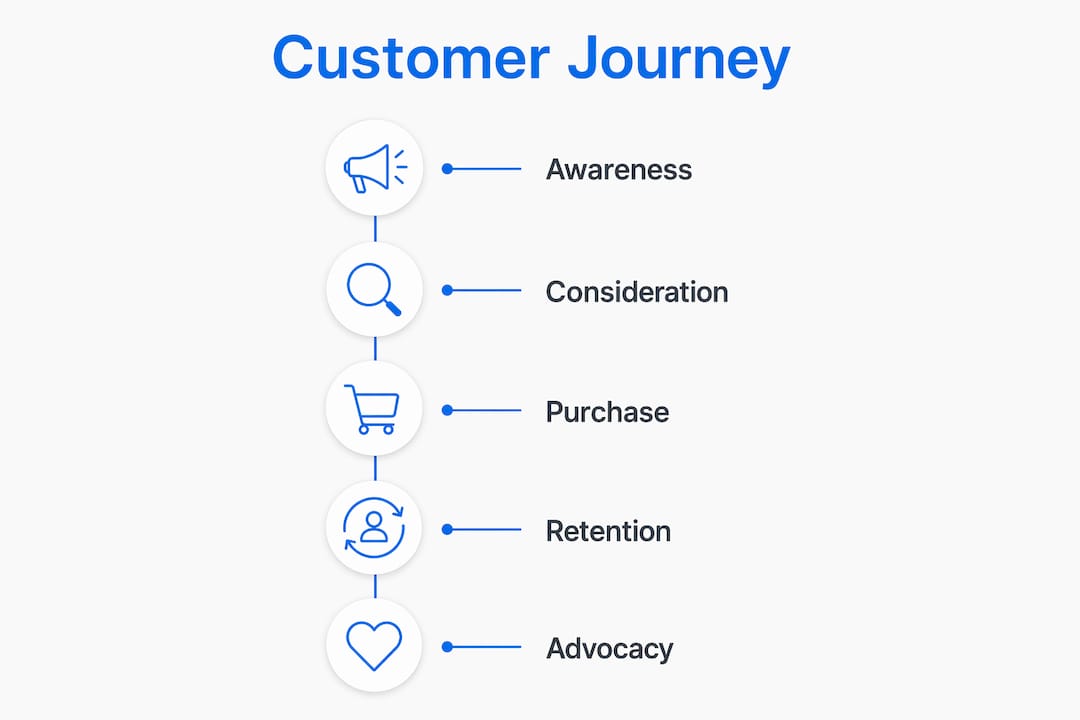
Effective data analysis in marketing starts with segmentation. Grouping customers by behavior, purchase history, or acquisition channel reveals patterns that aggregate metrics hide. A segment of customers who purchase twice in 30 days behaves very differently from first-time buyers, and each group needs a different message.
Attribution modeling answers a specific question: which channels and touchpoints actually drove a conversion? Common models include last-click, first-click, and linear attribution. Each tells a different story. Last-click attribution, for example, consistently over-credits paid search while under-crediting the blog post or social ad that started the relationship.
The most useful insights from journey analysis tend to fall into four categories:
- Drop-off points: Pages or steps where customers exit before converting
- High-value paths: Sequences of touchpoints that correlate with larger orders or repeat purchases
- Channel overlap: Customers who engage across email, paid, and organic before buying
- Segment behavior gaps: Differences in how new versus returning customers navigate your site
Each of these insights feeds directly into campaign decisions. If 40% of your customers visit a pricing page twice before converting, that is a signal to add a comparison tool or a live chat prompt on that page.
What are the best practices for activating insights through personalization and experimentation?
Insight without action is just a report. Activation is where data-driven marketing strategies produce actual revenue. The most effective activation approach combines personalization with systematic experimentation, and the two must be connected at the platform level.
Integrating analytics with activation platforms like Adobe Target for A/B testing and Adobe Journey Optimizer for campaign orchestration is what closes the loop between insight and execution. Without that integration, your analytics team and your campaign team are working from different versions of reality.
Running valid experiments requires discipline. Follow these steps to avoid the most common statistical traps:
- Define your hypothesis first. State exactly what you expect to change and why, before touching any campaign settings.
- Calculate your minimum detectable effect (MDE). The MDE tells you the smallest improvement your test can reliably detect given your sample size. Underpowered tests due to MDE mismatch produce inconclusive results that waste budget and time.
- Set your sample size before launch. Decide how many visitors or contacts the test needs, then do not check results until you hit that number.
- Avoid early stopping. Ending a test when results look promising is one of the most common errors in marketing experimentation. It inflates false positives and leads to bad decisions.
- Control for multiple comparisons. Testing five variations at once without adjusting your significance threshold increases the chance of a false positive by a wide margin.
- Run holdout experiments. A holdout group, a segment that receives no treatment, measures the true incremental lift of your campaign rather than correlation.
Incrementality testing takes this further. A Rocket Mortgage case study cited by Google showed that incrementality testing proved a campaign generated 23% more value than original estimates. That finding directly changed how the company allocated its marketing budget. That is the kind of result that earns marketing a seat at the finance table.
Pro Tip: Treat experimentation as a recurring operating cadence, not a one-off project. Schedule test cycles quarterly, assign owners, and document every result. Teams that run experiments consistently build a compounding knowledge base that improves every future campaign.
How do you measure marketing activities and tie them to business outcomes?
Measurement is the step most SMB marketing teams skip or do poorly. Tracking clicks and impressions is not measurement. Measurement means connecting marketing activity to revenue, customer lifetime value, and pipeline contribution.
The KPIs worth tracking fall into three tiers:
- Efficiency metrics: Cost per lead, cost per acquisition, email open rates
- Revenue metrics: Marketing-influenced revenue, pipeline contribution, average order value
- Loyalty metrics: Customer lifetime value, repeat purchase rate, net promoter score
Tools like Adobe Marketo Measure map every touchpoint in the buyer journey to closed revenue. That level of attribution shows which campaigns actually drive deals, not just traffic. For SMBs without enterprise budgets, Google Analytics 4’s conversion paths and Looker Studio dashboards provide a workable alternative.
The continuous cycle of data-driven decision-making means measurement is never a final step. Every result feeds back into the next campaign brief. A campaign that underperforms on LTV but overperforms on acquisition volume tells you something specific about your audience mix. That lesson belongs in the next planning session, not in a report that no one reads.
“Data-driven marketing is not about having more data. It is about building systems that turn measurement directly into business decisions, in repeated cycles.” — Adobe
Connecting marketing ROI to business outcomes is especially critical for SMBs, where every dollar of budget carries more weight than it does at an enterprise. When you can show that a specific email sequence generated $40,000 in pipeline last quarter, you stop having budget conversations based on opinion.
Key takeaways
Data-driven marketing decisions require a connected system of clean data, rigorous analysis, disciplined experimentation, and outcome-focused measurement to produce repeatable business results.
| Point | Details |
|---|---|
| Start with a phased CDP | Implement one high-value use case first, then expand after proving measurable results. |
| Fix identity resolution early | Configure matching and merge rules before running segmentation or personalization campaigns. |
| Power your experiments correctly | Calculate MDE and set sample sizes before launch to avoid false positives and wasted budget. |
| Use incrementality testing | Holdout experiments prove true campaign lift, not just correlation, which builds CFO confidence. |
| Tie every metric to revenue | Track LTV, pipeline contribution, and acquisition cost, not just clicks and impressions. |
The cultural shift nobody warns you about
Most articles on data-driven marketing focus on tools. The harder problem is culture. I have worked with SMB marketing teams that had Google Analytics 4, a CDP, and a solid email platform, and still made decisions based on whoever spoke loudest in the room. The technology was not the bottleneck. The habit of asking “what does the data say?” before acting was.
Adobe frames this directly: data-driven marketing is a cultural shift, not a technology adoption. Organizations that succeed build systems of inquiry, meaning they treat every campaign as a question, not a statement. They document what they expected, what happened, and what they learned. That discipline compounds over time in a way that no single tool purchase ever will.
My honest advice for SMB marketing leaders: do not wait until your data infrastructure is perfect. Start with the data you have, run your first experiment with a simple A/B test in your email platform, and measure one outcome clearly. The habit of testing and learning is more valuable than the perfect tech stack. Build the cadence first. The tools will follow.
One more thing I have seen trip up growing teams: they treat measurement as a reporting function rather than a decision function. Reports go into folders. Decisions change campaigns. Every measurement cycle should end with one specific change to the next campaign, not a summary slide.
— Eric
How Marvingrowthpartners helps SMBs build data-driven marketing systems
Marvingrowthpartners works with small and medium-sized businesses that need executive-level marketing thinking without the cost of a full-time hire. The team aligns growth strategy with hands-on execution, which means your data infrastructure, campaign cadence, and measurement systems all connect to the same business goals.
Whether you need fractional marketing leadership to lead your analytics and campaign strategy, or website optimization to turn more of your traffic into measurable leads, Marvingrowthpartners builds the systems that make data work for your business. See the full methodology at our approach and reach out to start a conversation about where your marketing data can take you.
FAQ
What does it mean to implement data-driven marketing decisions?
It means using customer data, analytics, and structured experiments to guide every major marketing action rather than relying on instinct. The goal is measurable business outcomes, not just better-looking reports.
What tools do SMBs need to start data-driven marketing?
A CDP for data centralization, a web analytics platform like Google Analytics 4 or Adobe Analytics, and a self-service reporting tool like Looker Studio or Tableau cover the core needs for most SMB marketing teams.
How do you avoid bad results from A/B testing?
Calculate your minimum detectable effect before launch, set a fixed sample size, and never stop a test early based on preliminary results. Early stopping is the leading cause of false positives in marketing experimentation.
What is incrementality testing and why does it matter?
Incrementality testing uses a holdout group that receives no campaign treatment to measure the true lift your marketing generates. A Rocket Mortgage case study showed this method revealed 23% more campaign value than standard estimates, directly improving budget decisions.
How do SMBs connect marketing activity to revenue?
Track pipeline contribution, customer lifetime value, and cost per acquisition alongside efficiency metrics. Tools like Adobe Marketo Measure and Google Analytics 4 conversion paths map touchpoints to closed revenue, giving marketing a clear financial story.