

What Is Integrated Marketing Strategy: A 2026 Guide
An integrated marketing strategy is defined as the coordinated alignment of campaigns, messaging, and data across all owned, earned, and paid channels so every customer interaction works toward the same business objective. Where most companies run email, social, paid media, and content as separate operations, integration treats them as one connected system. Brands like Panera Bread and KFC Spain have demonstrated that this approach drives measurable gains in retention and revenue. Tools like Braze and platforms like HubSpot provide the operational infrastructure to make it work at scale. If your marketing feels fragmented, this guide explains exactly why and how to fix it.
What is integrated marketing strategy and how does it work?
An integrated marketing strategy, formally known as Integrated Marketing Communications (IMC), is an operating model that unites campaigns, data, and messaging so every channel reflects the same customer perspective. The goal is not just visual consistency. It is structural alignment where your email team, paid media team, and content team share data, coordinate timing, and reinforce the same narrative.
The practical effect is that a customer who sees your Instagram ad, opens your follow-up email, and visits your website encounters one coherent story. Without integration, those three touchpoints often contradict each other in tone, offer, or timing. That contradiction erodes trust faster than any single bad ad.
IMC operates across three channel categories: owned (your website, email list, app), earned (press, reviews, organic social), and paid (display, search, sponsored content). Integration means these three categories are not managed in isolation. They share audience data, campaign goals, and performance metrics.

How does integrated marketing differ from multi-channel and omnichannel?
These three terms are frequently used interchangeably, but they describe distinct operating models. Understanding the difference prevents you from investing in the wrong infrastructure.
Multi-channel marketing means your brand is present on multiple platforms. Each channel operates independently with its own goals, metrics, and messaging. There is no requirement for coordination. A company running Facebook ads, sending newsletters, and publishing blog posts is doing multi-channel marketing, even if none of those efforts reference each other.
Integrated marketing adds coordination. Aligned messaging across channels eliminates silos and creates a unified customer experience. The channels still serve different functions, but they operate from a shared strategy, shared data, and shared creative direction.
Omnichannel marketing takes integration further by prioritizing a frictionless customer experience regardless of where or how a customer engages. Integrated marketing is the operational backbone that makes omnichannel possible. You cannot deliver a seamless omnichannel experience without first integrating your data and messaging infrastructure.
| Approach | Channel coordination | Data sharing | Customer experience focus |
|---|---|---|---|
| Multi-channel | None | Siloed | Channel-specific |
| Integrated marketing | High | Shared | Consistent and unified |
| Omnichannel | Full | Centralized | Frictionless across all touchpoints |
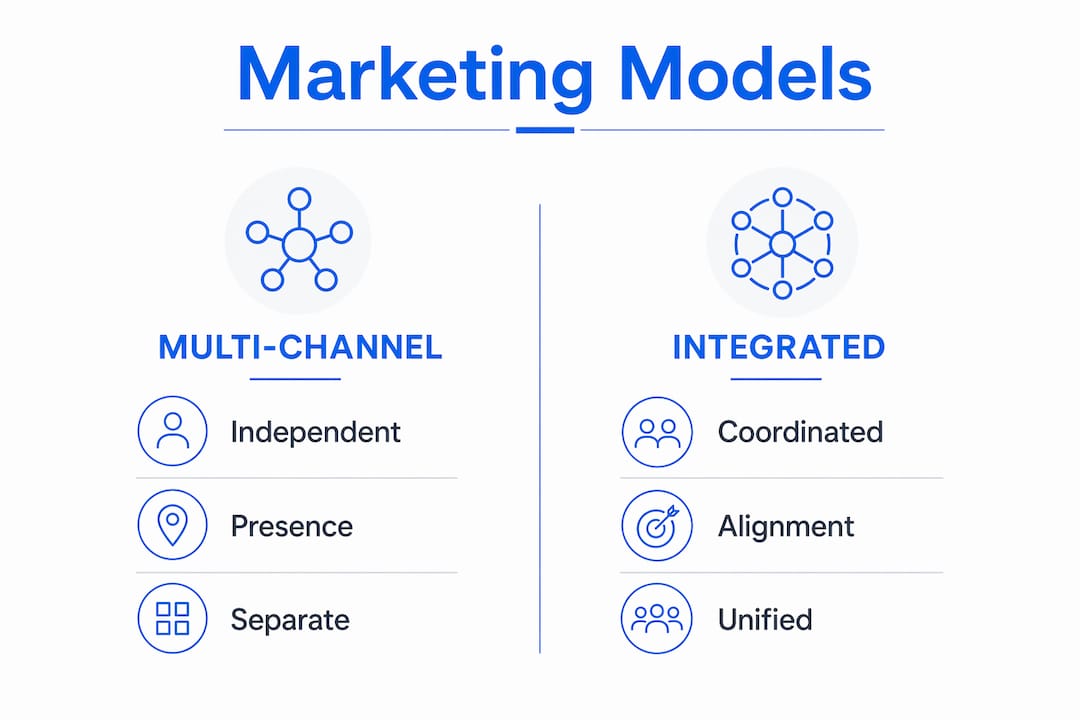
The key takeaway: multi-channel is about presence, integrated is about coordination, and omnichannel is about experience. Most growing businesses should target integrated marketing as the realistic and high-impact middle ground.
What are the benefits and challenges of integrated marketing?
The benefits of integrated marketing are concrete and measurable, not theoretical. Integrated marketing eradicates silos to increase reach, trust, and cost efficiency simultaneously. When your creative assets are built for cross-channel use, you spend less producing variations and more on distribution and optimization.
The core benefits include:
- Consistent brand experience: Customers receive the same message regardless of where they encounter your brand, which builds recognition and trust over time.
- Higher engagement rates: Coordinated campaigns that reinforce each other across touchpoints generate stronger recall and response than isolated channel efforts.
- Cost efficiency: Shared assets, unified briefs, and coordinated production reduce redundant work across teams.
- Better measurement: Cross-channel attribution reveals which touchpoints actually drive conversions rather than crediting only the last click.
- Reduced message fatigue: Automation routing prevents customers from receiving the same message across email, SMS, and push within hours of each other.
The challenges are equally real. Channel drift is the most common failure mode. It happens when teams operate from aligned strategy documents but disconnected data systems. The strategy says one thing; the execution diverges because no one is sharing real-time customer data. Alignment-by-document without shared technology is a structural flaw, not a communication problem.
Coordination complexity also increases as you add channels. Each new platform requires a channel owner, a content adaptation plan, and a reporting integration. Without clear ownership, campaigns stall or go live inconsistently.
Pro Tip: Assign a single integration lead who owns the master campaign brief and has visibility into every channel’s execution calendar. This role prevents drift more effectively than any tool alone.
How to build and execute an integrated marketing campaign
Building an integrated marketing campaign requires a structured workflow, not just a creative brief. HubSpot’s 7-step integrated campaign process provides a practical framework that works for teams of any size.
- Set campaign goals. Define one primary objective tied to a business metric. Revenue, lead volume, or retention rate. Every channel decision flows from this.
- Choose your channels. Select channels based on where your audience actually spends time, not where you are most comfortable. Refer to your marketing strategy types to match channel mix to growth stage.
- Define personas per channel. The same buyer behaves differently on LinkedIn versus Instagram. Tailor the persona lens for each platform while keeping the core message consistent.
- Assign channel owners. Each channel needs one accountable person who understands both the platform and the campaign strategy. Assigning channel ownership prevents either total inconsistency or rigid copy-paste messaging that ignores platform norms.
- Create adaptable assets. Build a core message and visual identity, then adapt them for each channel’s format and audience behavior. A 30-second video becomes a static ad, a blog section, and an email header. One source, multiple expressions.
- Launch with coordinated timing. Sequence your channel launches so they reinforce each other. A paid media push that coincides with an email campaign and a social series creates compounding attention rather than scattered impressions.
- Measure and iterate cross-channel. Unified analytics and CRM data are required for accurate attribution. A channel that looks weak in isolation may be the critical first touchpoint in a conversion sequence. Evaluate performance at the campaign level, not just the channel level.
Data centralization is the technical requirement that makes this workflow function. Without a unified customer profile, you cannot coordinate timing, prevent redundant outreach, or attribute conversions accurately. Platforms like Braze handle automation routing across email, SMS, and push to prevent customers from receiving the same message through multiple channels simultaneously.
The role of data in your marketing strategy is not supplementary. It is the connective tissue that holds integrated execution together.
Pro Tip: Build your campaign brief so the core message fits in one sentence. If your team cannot summarize the campaign in a single sentence, the channels will drift. Clarity at the brief stage prevents confusion at the execution stage.
What do real-world integrated marketing campaigns look like?
Two brand cases illustrate what successful integration looks like in practice and what it produces.
Panera Bread executed an integrated campaign during a major menu transformation by coordinating email, push notifications, and in-app messaging around the same narrative. Each channel served a different function in the customer journey: email built awareness, push drove urgency, and in-app messaging converted. The channels shared audience data so customers were not contacted redundantly, and the messaging adapted to where each customer was in their relationship with the brand.
KFC Spain coordinated CRM data, digital advertising, and out-of-home placements to drive record app sales. The campaign worked because CRM, digital, and offline channels shared data and timing. A customer who saw a billboard and then received a targeted app notification was not experiencing two separate campaigns. They were experiencing one coordinated story.
| Brand | Channels integrated | Primary outcome |
|---|---|---|
| Panera Bread | Email, push, in-app messaging | Improved customer retention during menu change |
| KFC Spain | CRM, digital ads, out-of-home | Record app sales during campaign period |
The lesson from both cases is the same: the channel mix matters less than the data and coordination model behind it. A high-impact campaign is not defined by how many channels it uses. It is defined by how well those channels share information and reinforce each other.
Integrated marketing is most effective when it is buyer-centric, meaning communications are tailored to where each customer is in their journey rather than broadcasting a uniform message to everyone. Panera and KFC Spain both succeeded because they treated integration as a customer relationship model, not a production efficiency exercise.
Key takeaways
An integrated marketing strategy succeeds only when shared data, clear channel ownership, and coordinated execution replace siloed operations and aligned-only-on-paper strategy documents.
| Point | Details |
|---|---|
| Define integration structurally | Align campaigns, data, and messaging operationally, not just visually or in a brief. |
| Distinguish from multi-channel | Multi-channel is presence; integrated marketing is coordination with shared data and strategy. |
| Assign channel ownership | Each channel needs one accountable owner to prevent drift and inconsistent execution. |
| Measure cross-channel | Evaluate campaign performance holistically; isolated channel metrics undercount true impact. |
| Use real-world models | Panera Bread and KFC Spain show that data sharing and sequencing drive measurable results. |
Why integration is harder than it looks, and worth it anyway
The most common mistake I see business owners make is treating integrated marketing as a messaging exercise. They align the copy, match the colors, and call it done. Six weeks into the campaign, the email team is promoting one offer, the paid team is running a different one, and the social team has gone off-script entirely. That is not a creative failure. It is a data and ownership failure.
What actually holds integration together is a shared customer data layer and someone whose job it is to enforce the campaign brief across every channel. Without those two things, even the best strategy document becomes decoration. I have watched companies invest heavily in creative production only to see the campaign fragment at the execution stage because no one owned the coordination function.
The other thing worth saying plainly: integration does not mean uniformity. The best integrated campaigns I have seen adapt the core message to each channel’s native behavior. A LinkedIn post and an SMS message should not read identically. They should feel like they come from the same brand, serving the same campaign goal, but written for the specific context of each platform. That balance between consistency and adaptation is where most teams struggle, and where the real skill of integrated marketing lives.
The future of this discipline runs through AI-powered personalization and real-time orchestration. Tools are getting better at routing messages based on individual behavior rather than segment rules. But the underlying principle does not change: every touchpoint must serve the customer’s journey, not the channel manager’s convenience.
— Eric
How Marvingrowthpartners helps you build integrated campaigns that hold together
If your marketing channels are producing results in isolation but not compounding into growth, the problem is usually structural, not creative.
Marvingrowthpartners specializes in aligning executive-level strategy with hands-on execution to build the kind of coordinated systems that prevent channel drift and drive measurable ROI. The team works directly with business owners and marketing leads to map your current channel mix, identify coordination gaps, and build workflows that keep messaging, data, and timing aligned across every touchpoint. No recycled playbooks. No generic frameworks. Visit Marvingrowthpartners to explore how a tailored integration model fits your growth stage and team structure.
FAQ
What is the core definition of integrated marketing strategy?
An integrated marketing strategy coordinates campaigns, messaging, and data across all owned, earned, and paid channels so every customer interaction works toward the same business objective. It is an operating model, not just a creative approach.
How is integrated marketing different from multi-channel marketing?
Multi-channel marketing means being present on multiple platforms independently. Integrated marketing adds coordination, shared data, and unified messaging so channels reinforce each other rather than operating in isolation.
What causes integrated marketing campaigns to fail?
The most common failure is alignment-by-document without shared technology and data. Teams agree on strategy but execute from disconnected systems, causing channel drift and redundant or conflicting messages.
What tools support integrated marketing execution?
Platforms like Braze handle cross-channel automation routing across email, SMS, and push notifications. HubSpot provides campaign workflow infrastructure. Both require a centralized customer data model to function effectively.
How do you measure the success of an integrated marketing campaign?
Measure at the campaign level using cross-channel attribution, not individual channel metrics. A channel that appears weak in isolation may be the critical first touchpoint in a conversion sequence, which siloed reporting will miss entirely.