

Why Local Entrepreneurs Need Brand Identity to Grow
Brand identity is the complete system of visual, verbal, and experiential elements that tells customers who you are, what you stand for, and why they should choose you over anyone else. For local entrepreneurs, this system is not a luxury. It is the foundation that determines whether your business gets remembered or ignored. Consistent branding correlates with 33% revenue growth and reduces the need for increased marketing spend. That single fact reframes branding from a design expense into a growth mechanism.
Why local entrepreneurs need brand identity to compete
Brand identity is the reason a customer walks past three similar shops and into yours. Without it, you are invisible in your own market. The importance of brand identity shows up most clearly in how customers make decisions: 81% of buyers require trust before they purchase from a business. Trust does not come from a single interaction. It builds across repeated, consistent exposures to your brand.
Local entrepreneurs face a specific challenge here. You do not have the advertising budget of a national chain. You cannot buy your way into customer memory. What you can do is build a brand identity so clear and consistent that every touchpoint, from your storefront sign to your Instagram profile to your business card, reinforces the same message. That repetition is what creates recognition.

The numbers support early action. Inconsistent branding forces businesses to spend 1.75x more on marketing to achieve the same results as a business with a clear identity. It also reduces pricing power by 14%–25%. Those are real costs that compound over time and quietly drain a small business.
How does brand identity build trust and customer recognition?
Customers need 5 to 7 brand impressions before they reliably recall a business. That number has a direct implication: every touchpoint either builds toward recognition or resets the clock. A local bakery with a consistent logo, color palette, and tone of voice across its packaging, window display, and social media reaches that recall threshold faster than one that changes its look every few months.
Visual recognition happens faster than most entrepreneurs realize. Customers form opinions about brand visuals within 50 milliseconds, before they read a single word. That means your visual identity does the heavy lifting before your message even lands. A mismatched font, an off-brand color, or a low-quality image can undermine trust in less time than it takes to blink.
The retention data is equally clear. Small businesses with consistent visual identities have nearly double the customer retention rates compared to those without identifiable branding. Retention is where local businesses win. A loyal customer who returns monthly and refers neighbors is worth far more than a one-time visitor. Brand identity is the mechanism that creates that loyalty.
Key trust-building functions of a strong brand identity:
- Consistency signals reliability. Customers read a consistent brand as a reliable business.
- Visual recognition shortcuts the decision process. Familiar brands feel safer to buy from.
- Tone of voice builds personality. A brand that sounds the same everywhere feels like a person, not a transaction.
- Professional presentation signals competence before any product is evaluated.
What components make up a strong, consistent brand identity?
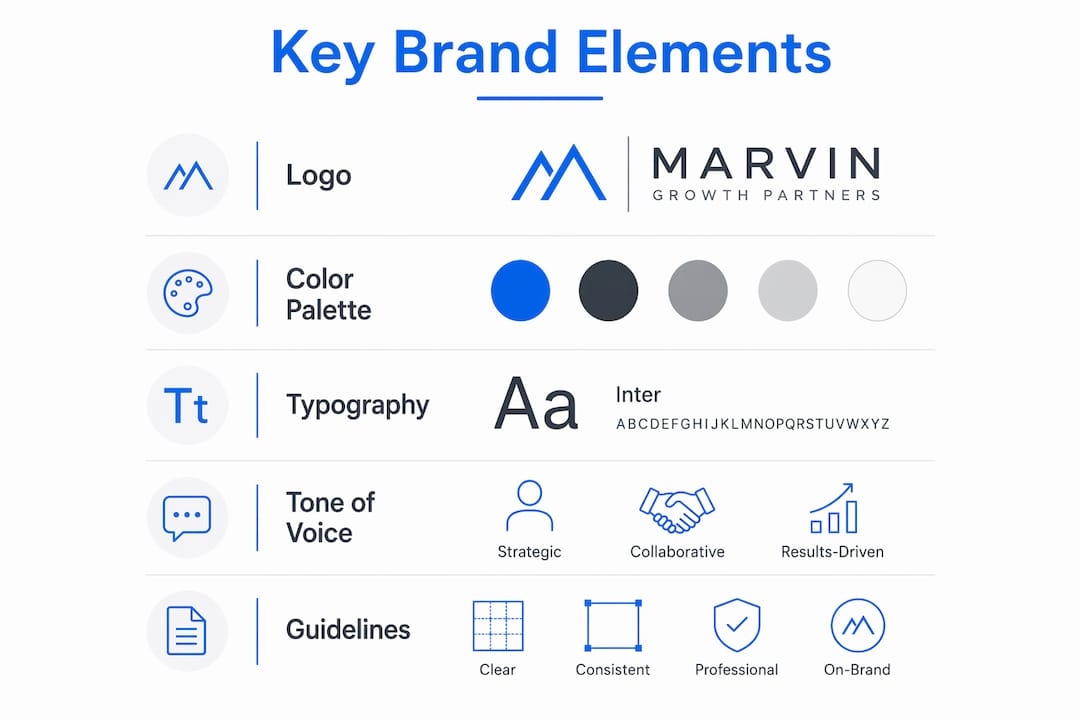
Brand identity is a system, not just a logo. Entrepreneurs who treat a logo as their entire brand miss the point entirely. A logo is one element in a larger system that includes color palette, typography, imagery style, and tone of voice. Each element plays a functional role.
The core components of a complete brand identity system:
- Logo and logo variants — A primary logo plus simplified versions for small formats, dark backgrounds, and social media avatars.
- Color palette — Typically 2–4 colors with defined hex codes, used consistently across every material.
- Typography — One or two typefaces with rules for headings, body text, and captions.
- Imagery style — A defined approach to photography, illustration, or graphic style that makes every image feel like it belongs to the same brand.
- Tone of voice — The personality and language style used in all written communication, from website copy to text message replies.
- Brand guidelines document — A written manual that documents all of the above and tells anyone creating materials exactly how to use them.
| Brand element | Function | Common mistake |
|---|---|---|
| Logo | Primary recognition anchor | Using too many variants or low-res files |
| Color palette | Emotional association and recall | Picking colors without consistency rules |
| Typography | Readability and personality | Mixing too many fonts across materials |
| Tone of voice | Personality and trust | Switching between formal and casual randomly |
| Brand guidelines | Operational consistency | Not documenting or sharing with vendors |
The brand guidelines document deserves special attention. A documented brand guide standardizes 70% of future marketing decisions and prevents repetitive design work. Every time you hire a freelancer, print new materials, or launch a new platform, the guidelines eliminate guesswork and keep your brand coherent.
Pro Tip: Before you hire a designer, write a one-page brief that describes your brand in three words, names your ideal customer, and lists two brands you admire. That brief will save hours of revision and produce a far better result.
Why is early investment in brand identity the smarter move?
The cost of waiting is higher than most entrepreneurs expect. Rebranding 12–18 months after launch is significantly more costly and risky than building a clear identity from the start. You waste the assets you already created, confuse customers who learned your old look, and lose the brand equity you spent months building.
Early investment in brand identity pays off in several ways:
- Lower marketing spend. A clear identity produces more recognition per dollar spent on advertising.
- Higher pricing power. Branded businesses command better prices because customers perceive more value.
- Faster credibility. A professional brand signals competence before a customer reads a single review.
- Broader business impact. Strong branding attracts better partners, improves vendor negotiations, and helps recruit talent by signaling that your business is serious.
A local entrepreneur without a clear brand identity competes on price by default. Price competition is a race to the bottom that no small business wins long-term. Brand identity is the tool that lets you compete on value instead.
Branding is also foundational for new businesses that lack reviews or social proof. Branding from day one establishes trust in the absence of those signals. A new restaurant with a polished, consistent brand feels more trustworthy than an established one with a chaotic visual presence. That perception gap is real, and it directly affects foot traffic and sales.
Pro Tip: Treat your brand identity as infrastructure, not decoration. Build it before you print your first business card, launch your website, or post on social media. Retrofitting a brand is always harder than building it right the first time.
How can local entrepreneurs build a practical brand identity?
Building a brand identity does not require a large budget. It requires clarity and consistency. The process follows a logical sequence that any local entrepreneur can execute.
- Define your brand core. Write down your mission, your values, and the one thing you do better than anyone else in your market. This is your foundation.
- Identify your ideal customer. Describe them specifically: age range, values, what they care about, and what problem you solve for them. Every brand decision flows from this.
- Develop your visual identity. Work with a designer or use a structured brief to create a logo, color palette, and typography system. Keep it simple. Simple scales better.
- Write your tone of voice guidelines. Choose three to five words that describe how your brand sounds. Friendly? Direct? Expert? Warm? Apply those words to every piece of copy you write.
- Document everything in a brand guidelines file. A two-page PDF is enough to start. Share it with every vendor, designer, and team member who creates materials for your business.
- Audit your existing touchpoints. Check your website, social profiles, signage, packaging, and email signature. Bring them into alignment with your new guidelines.
| Touchpoint | What to check | Fix priority |
|---|---|---|
| Website | Logo, colors, fonts, tone | High |
| Social media profiles | Profile image, bio, post style | High |
| Physical signage | Logo version, colors | Medium |
| Business cards | Full identity system applied | Medium |
| Email signature | Logo, font, contact format | Low |
The most common pitfall for local entrepreneurs is treating a DIY logo as a complete brand. A logo without a system behind it produces inconsistent materials, mixed messages, and weak recognition. The second most common pitfall is inconsistent messaging, where the website sounds formal, the social media sounds casual, and the in-store experience feels like a third business entirely.
Local market context matters too. Your brand identity should reflect the community you serve. A neighborhood coffee shop in a historic district should feel different from one in a tech corridor, even if the coffee is identical. That local specificity is a competitive advantage that national chains cannot replicate. Pair your brand identity work with community-focused marketing to reinforce your local presence.
Pro Tip: Review your brand identity every 12 months. Markets shift, audiences evolve, and your business grows. A brand that felt right at launch may need refinement after a year of real customer feedback.
Key Takeaways
Brand identity is the single most cost-effective investment a local entrepreneur can make to build recognition, earn trust, and reduce long-term marketing spend.
| Point | Details |
|---|---|
| Brand identity is a system | It includes logo, color palette, typography, tone of voice, and documented guidelines. |
| Trust requires repetition | Customers need 5–7 brand impressions before recall, so consistency across every touchpoint is non-negotiable. |
| Inconsistency costs money | Inconsistent branding forces 1.75x more marketing spend to achieve the same recognition results. |
| Early investment saves more | Rebranding after launch wastes assets and confuses customers; build it right from day one. |
| Branding extends beyond customers | A strong brand identity attracts partners, vendors, and talent, not just buyers. |
Brand identity is operational infrastructure, not a design project
I have worked with local entrepreneurs who spent months perfecting their product and launched with a generic logo from a free tool. Within a year, most of them were back at the drawing board, spending three times what they would have spent upfront. The pattern is consistent enough that I now treat it as a predictable mistake, not a surprise.
The entrepreneurs who get this right early share one mindset: they treat brand identity as infrastructure. The same way you would not open a restaurant without a kitchen layout, you should not launch a business without a brand system. Every decision you make later, from your website design to your packaging to how your staff answers the phone, will either reinforce or contradict your brand. Without a documented system, those decisions default to inconsistency.
The other thing I have seen clearly is that branding shapes how you see your own business. When you define your values, your voice, and your visual identity, you make better decisions across the board. You know which partnerships fit and which do not. You know what to say yes to and what to say no to. That clarity is worth more than any single marketing campaign. Local entrepreneurs who want to avoid the most common marketing mistakes almost always trace those mistakes back to a missing or inconsistent brand foundation.
— Eric
How Marvingrowthpartners helps local entrepreneurs build a real brand
Local entrepreneurs who want a brand identity that actually drives growth need more than a logo and a color palette. They need a system built around their specific market, their growth stage, and their customers.

Marvingrowthpartners works with local entrepreneurs to align brand identity with a full growth strategy that covers visibility, customer acquisition, and measurable results. The approach is built on real-world execution, not recycled templates. If you are building your brand from scratch or fixing an inconsistent one, the visibility assessment is the right starting point. It identifies exactly where your brand is losing recognition and where the fastest gains are. Marvingrowthpartners tailors every recommendation to your specific business, not a generic playbook.
FAQ
What is brand identity for a local business?
Brand identity is the complete system of visual and verbal elements, including logo, colors, typography, and tone of voice, that makes a business recognizable and trustworthy to its customers.
How does branding help local businesses compete with larger chains?
A clear, consistent brand identity lets local businesses compete on value and personality rather than price, which is an advantage national chains cannot easily replicate at the community level.
When should a local entrepreneur invest in brand identity?
Brand identity should be built before launch. Rebranding 12–18 months after launch is significantly more costly and risks confusing customers who already know your old look.
How many times does a customer need to see a brand before remembering it?
Customers typically need 5 to 7 brand impressions before they reliably recall a business, which means every touchpoint must deliver a consistent experience.
Does consistent branding actually increase revenue?
Businesses with consistent branding across all platforms see up to a 33% increase in revenue, and inconsistent branding reduces pricing power by 14%–25%.