

Product Branding's Role in Startup Growth
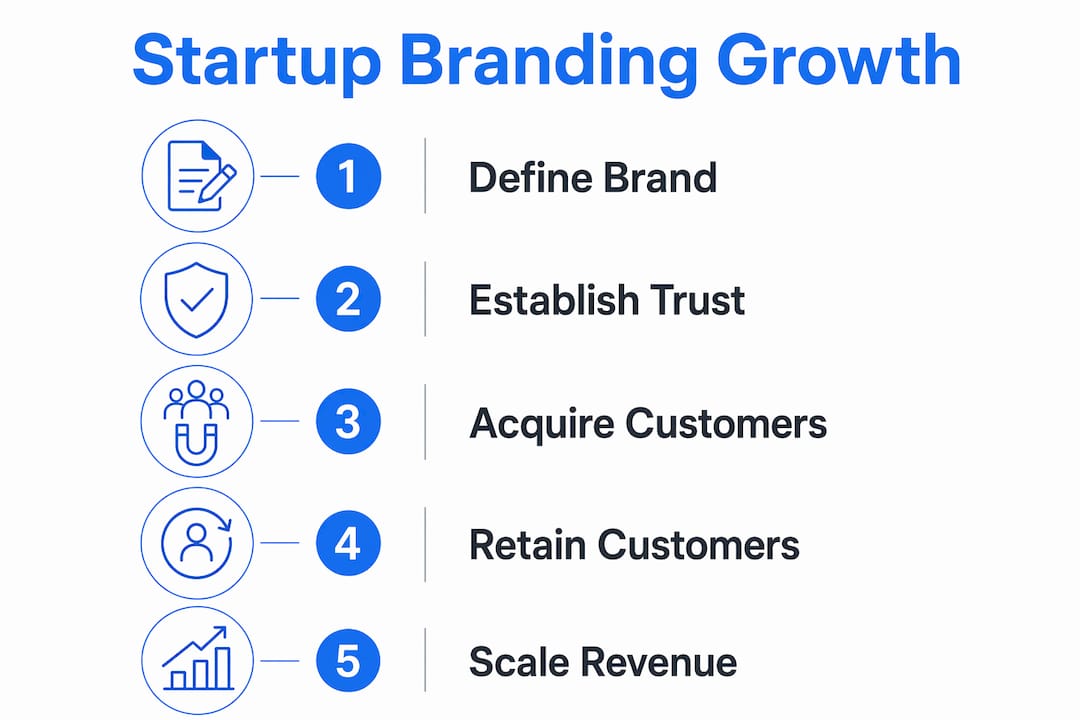
Product branding is the primary driver of differentiation, customer trust, and revenue growth for startups. The role of product branding in startup growth goes far beyond a logo or color palette. Strong brands represent over 30% of S&P 500 companies’ stock market value, which means brand equity is a real financial asset, not a soft concept. Startups that invest in brand identity early build a perception that compounds over time, making every marketing dollar work harder. The industry term for this is brand equity, and it is the foundation of every durable growth strategy.
How does product branding impact customer acquisition and retention?
Product branding directly affects how fast your startup acquires customers and how long they stay. Consistent brand presentation drives a 10–20% uplift in revenue, and buyers are willing to pay an average price premium of 1.6x for brands that produce thought-leadership content. That premium is not about charging more for the same thing. It reflects the trust your brand has built before the sales conversation even starts.

Strong brands reduce friction, shorten sales cycles, and lower customer acquisition costs across both paid and organic channels. Each of these effects compounds. A startup with clear, consistent messaging spends less to convert each lead, retains customers longer, and earns more referrals. The math favors early brand investment every time.
Here is what consistent branding does for your startup’s growth metrics:
- Conversion rates improve because buyers recognize and trust your name before they reach your sales team.
- Price sensitivity drops when customers associate your product with a clear value and identity.
- Churn decreases because customers who buy into a brand feel a stronger connection than those who bought on price alone.
- Referral rates increase when your brand gives customers a clear story to share with peers.
- Paid media efficiency rises because brand recognition lowers cost-per-click and improves ad quality scores.
25% of consumers prioritize brand trust over product features or ingredients. For a startup competing against established players, that trust gap is the single biggest barrier to growth. Branding closes it faster than any feature update.
Pro Tip: Lock down your brand voice, visual identity, and core messaging before you run your first paid campaign. Inconsistent branding in ads wastes budget and confuses prospects who later visit your website.
What is the role of founder branding in startup growth?
Founder branding is the most underused growth asset in early-stage startups. 76% of buyers trust a CEO more than the brand itself, and founder-led firms produced 2.1x total shareholder returns compared to non-founder-led peers between 2015 and 2024. Those numbers reframe the founder’s public presence as a revenue-generating activity, not a vanity project.
Founder visibility accelerates trust in ways that product marketing cannot replicate. When a founder speaks publicly about the problem their startup solves, they create authenticity that no brand campaign can manufacture. Founder personal branding ROI compounds via revenue, pipeline, hiring, and investor signals, making the founder a genuine distribution engine in the early years.
The practical framework most growth-focused founders use is a 40/60 split: 40% of content and visibility effort goes to the personal brand, and 60% goes to building the company brand. This ratio works because the founder’s credibility borrows trust to the product while the company brand builds independent equity over time.
Watch out for these pitfalls when building your founder brand alongside your product brand:
- Over-reliance on the founder’s name creates key-person risk. Investors and enterprise buyers notice when a company cannot stand without its founder.
- Neglecting the transition plan from founder-led to company-led brand leaves startups exposed when the founder steps back from content or sales.
- Misaligning founder messaging with product positioning creates market confusion. Your LinkedIn posts and your product page must tell the same story.
- Skipping institutional credibility building means the founder’s audience does not transfer to the company when it matters most, such as during fundraising or a major product launch.
Pro Tip: Start building your company’s brand positioning infrastructure from day one, even while you rely on your personal brand for early traction. The goal is a handoff, not a permanent dependency.
When should startups integrate branding into their growth strategy?
The right time to invest in branding is at the moment of product-market fit, not after. Brand investment is most impactful at growth inflection points such as post product-market fit, before fundraising, and before major launches. Investing before you have validated your product wastes resources on a story that may need to change. Waiting too long means you scale with a fragmented identity that costs far more to fix.
Brand is a perception built through consistent messaging, vision, and values locked down in the first 1–2 years. This is not a marketing task. It is an organizational decision that affects hiring, product design, customer support tone, and sales collateral. Founders who treat branding as a “marketing department problem” consistently underperform those who treat it as a company-wide operating system.
Here is a practical sequence for integrating branding into your growth strategy:
- Validate your product-market fit first. Branding a product that does not yet solve a real problem clearly is premature. Get signal from real customers before you codify your story.
- Define your brand architecture. Decide on your core positioning, your brand voice, and your visual identity. Write it down in a brand guide that every team member can access.
- Align your sales and marketing collateral. Every pitch deck, email sequence, and landing page must reflect the same positioning. Inconsistency at this stage kills conversion.
- Use data to refine your messaging. Data-driven brand approaches report marketing efficiency gains of up to 30% and incremental top-line growth of up to 10% without increasing budget. Run A/B tests on headlines and value propositions to find what resonates.
- Integrate brand into hiring. The people you hire represent your brand internally and externally. Culture and brand are the same thing at the early stage.
The table below maps brand investment priorities to startup growth stages:
| Growth stage | Brand priority | Key action |
|---|---|---|
| Pre-product-market fit | Low | Focus on customer discovery, not brand polish |
| Post-product-market fit | High | Lock down positioning, voice, and visual identity |
| Pre-fundraising | Critical | Align founder visibility with company brand narrative |
| Scaling and hiring | High | Embed brand into culture, onboarding, and communications |
| Major product launch | Critical | Unify all channels under one consistent message |
Pro Tip: Treat your marketing strategy as a living document. Revisit your brand positioning every six months during the first two years. Markets shift, and your messaging must keep pace.
What common branding pitfalls do startups face?
The most expensive branding mistake a startup can make is treating it as a cosmetic afterthought. Treating branding as a cosmetic expense leads to broken brand equity that is costly to fix. Rebranding a company that has already built market awareness costs significantly more in time, money, and customer confusion than getting it right the first time.
Startups that treat branding as parallel to product development improve conversion and reduce sales friction even before launch. The ones that delay it consistently report longer sales cycles, higher customer acquisition costs, and weaker investor confidence. These are not abstract risks. They show up directly in your growth numbers.
The most common pitfalls to avoid:
- Siloed branding efforts. When the design team controls the logo, the marketing team controls the messaging, and the founder controls the public narrative, the result is three different brands in one company.
- Ignoring unified messaging. Inconsistent language across your website, ads, and sales calls creates market confusion. Prospects who cannot quickly understand what you do will not buy.
- Underestimating rebranding costs. Changing your brand name, positioning, or visual identity after you have built an audience requires re-educating every customer and prospect you have earned.
- Neglecting the founder-to-company brand transition. Founder personal brand requires a planned transition to company-branded infrastructure to avoid key-person risk as the company scales.
- Skipping internal brand alignment. Your team is your brand’s first audience. If employees cannot articulate your positioning, your customers never will.
The fix for all of these is the same: treat branding as a decision system that aligns hiring, product experience, and customer communication from the start.
Key Takeaways
Product branding is a growth infrastructure decision, not a marketing expense, and startups that invest in it at product-market fit consistently outperform those that delay.
| Point | Details |
|---|---|
| Brand equity is a financial asset | Strong brands represent over 30% of S&P 500 stock market value, making brand a measurable business asset. |
| Consistent branding drives revenue | Consistent brand presentation can produce a 10–20% revenue uplift and a 1.6x price premium. |
| Founder brand amplifies growth | Founder-led firms deliver 2.1x shareholder returns; use a 40/60 personal-to-company brand split early on. |
| Time brand investment correctly | Invest at product-market fit, before fundraising, and before major launches for maximum impact. |
| Avoid siloed brand efforts | Unified messaging across all channels reduces sales friction and lowers customer acquisition costs. |
Why I think most startups get branding backwards
Most founders I work with treat branding as the thing they will do after the product is ready, after the first hire, after the first funding round. The logic sounds reasonable. Get the product right, then tell people about it. The problem is that by the time they are ready to “do branding,” they have already been telling people about it. Every email, every pitch, every social post has already built a perception. The question is whether that perception was intentional.
The startups that grow fastest are not the ones with the best products. They are the ones whose products are easiest to understand, trust, and recommend. That is a branding outcome. Founder visibility is a strategic leadership role that evolves from content engine to institutional credibility. The founders who recognize this early use their personal brand to open doors while simultaneously building a company brand that can stand on its own.
The other thing I have seen consistently is that branding is not a marketing function. It is a cultural one. The startups with the strongest brands have founders who talk about positioning in product reviews, in hiring conversations, and in board meetings. When branding lives only in the marketing team, it stays shallow. When it lives in the founder’s operating philosophy, it becomes a genuine competitive advantage. Your startup story is not a marketing asset. It is your growth strategy.
— Eric
How Marvingrowthpartners helps startups build brands that grow
Startups rarely lack ideas. They lack the systems to turn those ideas into consistent, credible market presence. Marvingrowthpartners works with founders to align brand strategy with execution, so your messaging, visibility, and sales motion all pull in the same direction.
Marvingrowthpartners does not hand you a generic playbook. The team builds growth systems tailored to where your startup actually is, whether that is locking down your positioning before a fundraise, aligning your founder brand with your product narrative, or improving the marketing efficiency of your existing spend. If you are ready to treat branding as the growth asset it is, explore the approach Marvingrowthpartners uses to help startups scale with clarity and confidence. You can also review the growth strategy services available for startups at every stage.
FAQ
Why is product branding important for startups?
Product branding builds the trust and recognition that reduce sales friction and lower customer acquisition costs. Startups with consistent brand presentation report revenue uplifts of 10–20% compared to those with fragmented messaging.
How does branding affect startup success in the early stages?
Branding affects startup success by shaping buyer perception before any sales conversation begins. Startups that lock down their positioning in the first one to two years build a foundation that makes every subsequent marketing effort more efficient.
What is the role of founder brand in startup growth?
The founder brand serves as the startup’s most credible early-stage distribution channel. Founder-led firms produce 2.1x total shareholder returns compared to non-founder-led peers, and 76% of buyers trust a CEO more than the company brand itself.
When should a startup start investing in branding?
The best time to invest in branding is immediately after achieving product-market fit. Branding before fit risks building a story around a product that may still change; branding after fit locks in a validated message at the moment the startup is ready to scale.
What branding strategies work best for new businesses?
The most effective branding strategies for new businesses combine a clear positioning statement, consistent visual identity, unified messaging across all channels, and a planned transition from founder-led to company-led brand as the organization grows.
Recommended
- Craft Your Startup Story for Marketing Success – Marvin Growth Partners
- Brand Positioning for SMBs: Your 2026 Growth Guide – Marvin Growth Partners
- Why Bootstrapped Marketing Strategies Work for SMBs – Marvin Growth Partners
- The Role of Social Media in Brand Presence for SMBs – Marvin Growth Partners