

How to Manage Marketing During Rapid Growth
Rapid growth marketing, the discipline of scaling marketing systems without proportionally increasing cost or complexity, is the defining challenge for companies moving from startup to scale. Most growing businesses make the same mistake: they add budget and headcount before fixing the underlying systems. The result is more noise, not more results. This guide gives you the exact frameworks to manage marketing during rapid growth, from building your tech stack to structuring your team and integrating AI into your execution.
What are the foundational tools for managing marketing at scale?
The infrastructure you build before scaling determines how far you can go. Clean conversion tracking, an efficient CRM, and a reporting framework tied to revenue, customer acquisition cost, and lifetime value are the non-negotiables. Without these, you are making decisions based on incomplete information.
Growing companies need a marketing tech stack that matches their ambitions. A smaller operation can run on basic email tools and a spreadsheet. A scaling company needs integrated systems that talk to each other and surface the right data at the right time.
| Component | Smaller operation | Scaling company |
|---|---|---|
| CRM | Basic contact list | HubSpot, Salesforce with pipeline tracking |
| Email marketing | Mailchimp standalone | Automated nurture sequences tied to CRM |
| Analytics | Google Analytics pageviews | Full funnel tracking with revenue attribution |
| Landing pages | Static website pages | Rapid A/B testing infrastructure |
| Reporting | Monthly manual reports | Weekly dashboards tied to business outcomes |
Before you scale any channel, document your growth strategy and align it with your business goals. Marketing without a documented direction produces fragmented campaigns that compete with each other for budget and attention. The role of data in this phase is not optional. It is the foundation every decision rests on.

Pro Tip: Audit your CRM data quality before adding any new marketing tools. Dirty data fed into new systems produces dirty outputs at higher cost.
Which high-leverage strategies maximize impact during rapid growth?
Scaling marketing means focusing on leverage, not spending more. The highest-leverage plays are those you document once and automate to multiply results without adding proportional effort. Three categories consistently outperform the rest: evergreen content, automated nurture flows, and referral systems.
Evergreen content compounds over time. A well-researched article or guide published today continues to generate organic traffic and leads for years. Content marketing built around high-intent search terms does not require ongoing ad spend to stay visible. That compounding effect is what separates it from paid campaigns, which stop the moment you stop paying.
Automated email nurture flows work while your team sleeps. A prospect who downloads a guide at 11 p.m. on a Saturday receives a relevant follow-up sequence without anyone on your team lifting a finger. Transitioning from paid-heavy tactics to evergreen SEO and nurture flows can reduce cost-per-lead by up to 70% and grow organic-led leads from roughly 10% to 60% within 12–18 months. That shift fundamentally changes your unit economics.
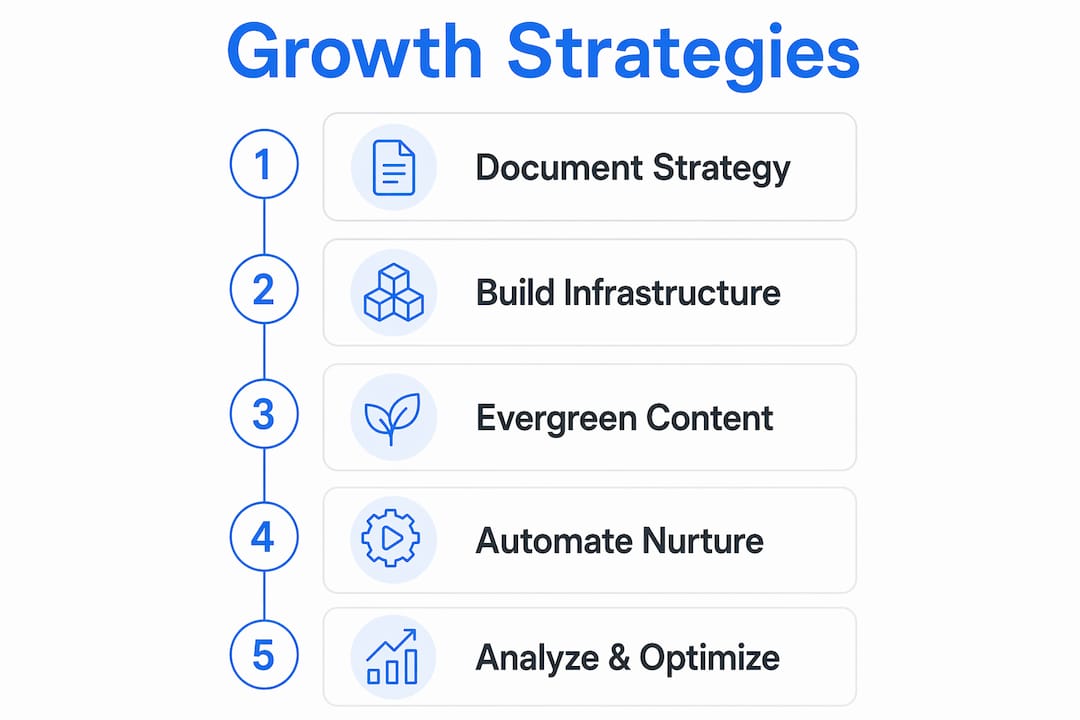
Referral systems and amplifier partnerships extend your reach without adding headcount. A structured referral program turns satisfied customers into a distribution channel. Partnerships with complementary brands expose you to pre-qualified audiences who already trust the referring source.
The top high-leverage marketing strategies for rapid growth are:
- Evergreen SEO content: Targets high-intent keywords and compounds in value over time
- Automated email nurture sequences: Converts leads at every hour without manual effort
- Referral programs: Turns customers into a low-cost acquisition channel
- Strategic partnerships: Reaches qualified audiences through trusted third parties
- Bootstrapped marketing tactics: Maximizes return on constrained budgets during growth phases
Pro Tip: Build your nurture sequences before you need them. Most teams build them reactively, which means leads fall through the gap during the exact period when growth is fastest.
How should marketing teams be structured during rapid growth?
Team structure is the most underestimated variable in scaling marketing strategy. Most companies hire reactively, filling the loudest gap rather than the most strategic one. The result is a team that is busy but not aligned.
High-growth marketing teams restructure their organization every 6–9 months to stay aligned with evolving business goals. That cadence sounds aggressive, but growth changes the job faster than most leaders expect. A team built for $2 million in revenue needs a different structure at $10 million.
The three phases of team scaling follow a clear pattern:
- Foundation phase: One generalist marketer or a small team handles all channels. The priority is proving which channels work, not specializing.
- Specialization phase: As channels prove out, hire specialists. Content, paid media, and demand generation each need dedicated ownership.
- Scale phase: Add leadership layers. A head of marketing or VP-level hire becomes necessary to coordinate across functions and connect marketing output to commercial goals.
Stripe’s principles recommend evaluating team structure every 6–9 months as a deliberate practice, not just when something breaks. Build that review into your calendar now.
Pro Tip: Before hiring your next marketer, write the job description and then ask whether a documented process or automation could do 60% of that job. If yes, build the system first.
Hiring more people without fixing broken marketing infrastructure increases cost and confusion rather than driving better results. The system has to come before the headcount. Every new hire dropped into a broken system learns the broken habits and makes them harder to change.
What operational systems keep marketing aligned during rapid growth?
Marketing becomes a coordination function during growth, connecting sales, leadership, product, and operations. When that coordination breaks down, campaigns launch without sales alignment, messaging contradicts itself across channels, and approvals stall campaigns that should have shipped weeks earlier.
Operational discipline is what separates companies that scale marketing effectively from those that scale chaos. The creative work matters, but it cannot ship efficiently without documented processes behind it.
The most common operational failures during rapid growth are:
- Reactive marketing: Campaigns built in response to competitor moves or leadership requests, with no connection to a documented plan
- Fragmented execution: Different teams running different messages with no shared calendar or approval process
- Missing reporting cadence: No weekly or biweekly review of what is working, so underperforming campaigns run too long
- CRM architecture gaps: Lead data that does not flow cleanly between marketing and sales, creating blind spots in the pipeline
Clear approval flows, documented processes, and aligned CRM architecture prevent the friction that erodes margins during fast growth. Build a shared campaign calendar that every stakeholder can see. Establish a weekly marketing review meeting with a fixed agenda. Document every repeatable process in a shared workspace, whether that is Notion, Confluence, or a Google Drive folder your team actually uses.
Pro Tip: Create a one-page campaign brief template and make it mandatory for every new campaign. It forces clarity before execution and cuts approval cycles in half.
How does AI change effective growth marketing in 2026?
AI adoption accelerates marketing effectiveness by raising both the creative ceiling and execution floor, requiring fast upskilling to keep pace with changing expectations. That means the bar for average work has risen. AI-generated content is everywhere, so content that does not demonstrate genuine expertise or original perspective gets ignored.
According to Dara Treseder, leading through AI-driven change is the defining challenge for marketers in 2026. The opportunity is real: AI tools cut production time for content, ads, and email sequences dramatically. The risk is equally real: teams that use AI to produce volume without quality damage their brand faster than they build it.
The practical applications of AI in growth marketing fall into three areas. First, content creation at scale: AI drafts, humans edit and add expertise. Second, search visibility: AI-powered tools now surface answers directly in search results, making AI search optimization a distinct discipline from traditional SEO. Third, automation: AI-driven workflows qualify leads, personalize outreach, and trigger campaigns based on behavior without manual intervention.
The role of AI in marketing strategies is expanding rapidly across content, targeting, and customer experience. Teams that upskill now build a durable advantage over those that wait.
Pro Tip: Assign one team member to own AI tool evaluation on a rolling 90-day basis. The tools change fast enough that a dedicated owner prevents your team from using outdated workflows.
Key takeaways
Effective growth marketing requires building systems first, then scaling people and spend on top of those systems.
| Point | Details |
|---|---|
| Build infrastructure before scaling | Clean CRM data, conversion tracking, and reporting must exist before you add budget or headcount. |
| Prioritize high-leverage plays | Evergreen content and automated nurture flows reduce cost-per-lead and compound in value over time. |
| Restructure teams every 6–9 months | Growth changes role requirements faster than most leaders expect; scheduled reviews prevent misalignment. |
| Operational discipline drives results | Documented processes, shared calendars, and clear approval flows prevent the friction that kills margins. |
| AI raises the bar for quality | AI tools accelerate execution, but teams must upskill to produce work that stands out in an AI-saturated market. |
What I’ve learned from watching companies scale marketing the wrong way
The pattern I see most often is this: a company hits a growth inflection point, the CEO panics about marketing, and the immediate response is to hire three people and double the ad budget. Six months later, the cost-per-lead is higher, the team is confused about priorities, and the CEO is more frustrated than before.
The problem was never a lack of people or budget. It was a lack of systems. Every dollar you spend on marketing runs through your infrastructure. If that infrastructure is broken, more dollars just reveal the cracks faster.
The companies that scale marketing well do something counterintuitive. They slow down before they speed up. They document what is working, automate the repeatable parts, and then hire people to do the work that cannot be automated. That sequence matters enormously.
On AI: the teams I see winning in 2026 are not the ones using the most AI tools. They are the ones who have figured out where AI accelerates human judgment and where it replaces it. Those are very different situations, and confusing them is expensive.
The most durable competitive advantage in growth marketing is not a channel or a tool. It is the discipline to measure, iterate, and build on what actually works rather than what feels exciting.
— Eric
How Marvingrowthpartners helps you scale marketing without the chaos
Growing companies need execution, not just advice. Marvingrowthpartners aligns executive-level strategy with hands-on execution to build the systems that make scaling marketing repeatable and measurable.
Whether you need a fractional marketing leader to drive your growth strategy or a full growth planning engagement to build your marketing infrastructure from the ground up, Marvingrowthpartners tailors every approach to your specific growth stage and business goals. No recycled playbooks. No generic frameworks. If you are ready to scale marketing with clarity and measurable results, explore the approach and connect with the team.
FAQ
What does it mean to manage marketing during rapid growth?
Managing marketing during rapid growth means building systems that multiply results without proportionally increasing cost or headcount. The focus is on automation, evergreen content, and operational discipline rather than simply adding budget.
How often should a growing company restructure its marketing team?
High-growth companies should review and restructure their marketing team every 6–9 months. Growth changes role requirements faster than annual reviews can address.
What is the biggest mistake companies make when scaling marketing?
The most common mistake is hiring more people before fixing broken marketing infrastructure. Adding headcount to a broken system increases cost and confusion without improving results.
How does evergreen content reduce marketing costs during growth?
Evergreen SEO content and automated nurture flows can reduce cost-per-lead by up to 70% and grow organic-led leads from roughly 10% to 60% within 12–18 months, shifting the economics away from paid dependency.
How should growing companies approach AI in their marketing strategy?
Growing companies should use AI to accelerate content production and automate lead workflows, while assigning a dedicated team member to evaluate new tools every 90 days. The priority is using AI where it amplifies human judgment, not where it replaces it.