

The Role of Social Proof in Local Marketing
Social proof is defined as the psychological phenomenon where consumers rely on the reviews, endorsements, and behaviors of others to make confident purchasing decisions. The role of social proof in local marketing is not a soft branding concept. It is a measurable driver of trust, foot traffic, and revenue. 66% of consumers perform additional research after reading a positive review, with 37% reading more reviews and 24% visiting social media. That cross-channel ripple effect means one good review can trigger a chain of discovery. Customers are also 92% more likely to trust a local brand endorsed by community members or influencers than one relying on traditional advertising alone. For local business owners and marketers, understanding how to build and display social proof is no longer optional.
How does social proof influence consumer behavior in local markets?
Social proof works because of conformity bias, the deeply human tendency to assume that if others approve of something, it is probably safe to try. In local markets, this effect is amplified. Consumers already feel a sense of community identity, so a neighbor’s recommendation carries more weight than a national ad campaign. The perceived risk of trying a new local business drops sharply when visible trust signals are present.
Different forms of social proof trigger different responses:
- Star ratings and review counts reduce uncertainty at the moment of decision
- Testimonials build emotional connection by telling a specific customer story
- Follower counts signal popularity and community acceptance
- Influencer endorsements transfer credibility from a trusted voice to your brand
- User-generated content (UGC) provides authentic, unscripted proof of real experiences
Each format serves a distinct purpose. Star ratings answer “Is this place any good?” Testimonials answer “Will this work for someone like me?” UGC answers “What does this actually look like in real life?” Deploying all three creates a layered trust architecture that accelerates decision-making.
Placing social proof where decisions happen is the key mechanism. Visible badges, star ratings, and top-rated comments placed directly at purchase points boost sales. This is not about decoration. It is about removing the last objection a buyer has before committing.
Pro Tip: Place your highest-rated review or a live star rating widget on your website’s homepage above the fold, not buried in a testimonials page. Buyers decide in seconds, and the trust signal needs to meet them immediately.
What are the most effective types of social proof for local marketing strategies?
Not all social proof carries equal weight in a local context. The format and source both matter. Local business owners who treat all reviews as interchangeable miss the opportunity to prioritize the signals that actually convert.
Customer reviews and star ratings
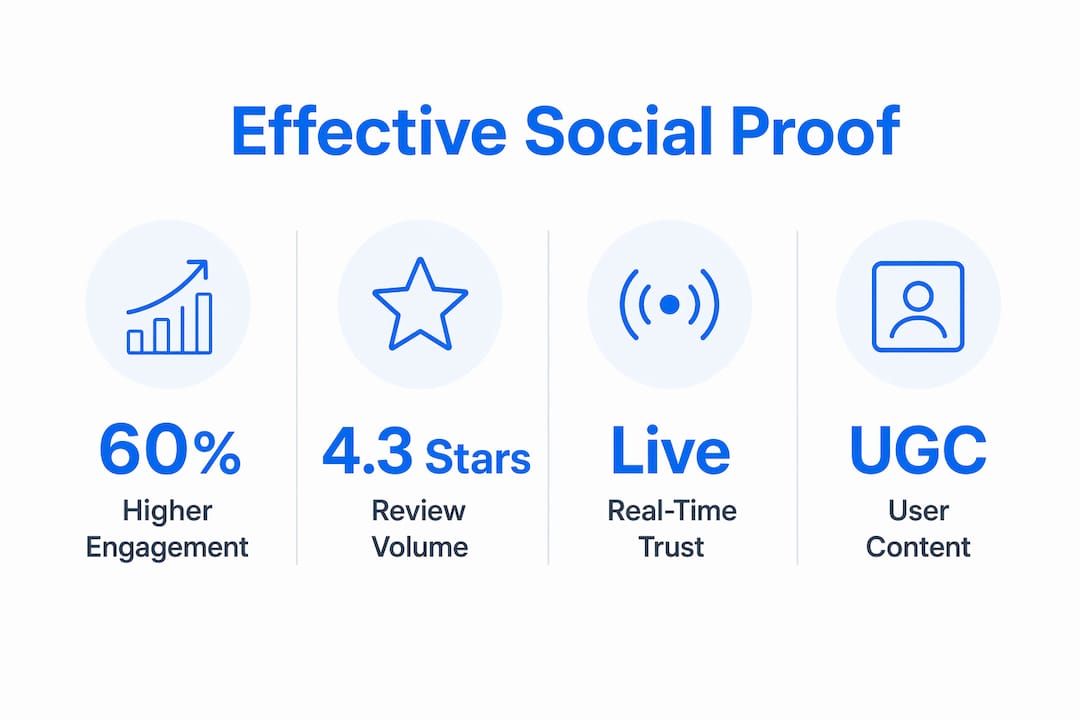
Review volume carries more weight than a perfect score in building local consumer trust. A business with 4.3 stars and 400 reviews consistently outperforms a competitor with 5 stars and 12 reviews. Consumers read volume as evidence of real-world experience. A handful of perfect scores reads as suspicious. A large body of mostly positive reviews reads as reliable.

The practical implication: prioritize generating more reviews over managing for perfection. A steady stream of honest, varied feedback builds the kind of trust that converts browsers into buyers.
Local micro-influencer endorsements
Micro-influencers with 5,000–50,000 followers deliver 60% higher engagement rates than macro-influencers for local campaigns. That gap exists because micro-influencers have genuine relationships with their audiences. Their followers are often neighbors, coworkers, and community members, which is exactly the audience a local business needs to reach.
Partnering with a local food blogger, a neighborhood fitness coach, or a community event organizer creates endorsements that feel earned rather than purchased. The authenticity is the asset.
Real-time vs. static social proof
| Format | Strength | Best use case |
|---|---|---|
| Live Google rating display | Creates curiosity at point of sale | In-store screens, window signage |
| QR code linking to reviews | Drives cross-channel engagement | Receipts, menus, packaging |
| Static poster with testimonial | Reinforces brand story | Waiting areas, checkout counters |
| UGC on social media | Builds ongoing authenticity | Instagram, Facebook, Google posts |
Real-time verifiable social proof, such as live Google rating displays and QR codes, builds stronger customer trust than static posters. The reason is psychological commitment. A live number feels current and credible. A printed quote feels curated and potentially outdated.
User-generated content and testimonials
UGC works because it is unscripted. When a customer posts a photo of your product or tags your location, they are vouching for you without being asked. Co-branded authentic customer experiences with influencers generate ripple effects of UGC that extend social proof sustainably. One well-executed influencer collaboration can produce dozens of secondary posts from that influencer’s audience.
How can local businesses integrate social proof into online and offline marketing?
The most effective local marketing strategies treat social proof as a system, not a one-time tactic. Every customer touchpoint is an opportunity to either generate or display trust signals.
-
Display live ratings in-store and online. Mount a screen near your entrance showing your live Google rating and review count. Live Google ratings and follower counts create curiosity and influence consumer decisions at the point of sale. Pair this with a matching widget on your website homepage.
-
Generate reviews without friction. Print QR codes on receipts, menus, and packaging that link directly to your Google review page. Follow up purchases with a short text or email asking for feedback. The easier you make it, the more reviews you collect.
-
Label your best sellers. Add “Best Seller,” “Most Loved,” or “Customer Favorite” tags to your top products or services, both in-store and online. These labels function as passive social proof. They tell the undecided buyer that others have already made this choice.
-
Leverage social media posts as proof. Repost customer photos and UGC to your own social channels with permission. This turns your feed into a living gallery of real customer experiences. Pair this with community marketing tactics to amplify reach within your local audience.
-
Respond to every review. Businesses that respond promptly and personally to all reviews improve trust perception and local SEO rankings. A response to a negative review shows accountability. A response to a positive review shows appreciation. Both signal to prospective customers that you are engaged and trustworthy.
-
Optimize your Google Business Profile. A complete, active profile with recent reviews and owner responses is one of the most visible forms of social proof in local search. Boosting your Google Business Profile directly increases the social proof signals that appear when customers search for you.
Pro Tip: Set a weekly calendar reminder to request reviews from your five most satisfied customers that week. Consistency in review generation matters more than any single campaign push.
What mistakes do local businesses make with social proof?
The most common mistake is treating social proof as a passive metric rather than an active asset. Many local businesses accumulate reviews and follower counts without ever displaying or activating them. The trust signal exists but never reaches the customer at the moment it would matter.
Other frequent errors include:
- Chasing macro-influencers for one-off posts. Generic sponsored content from a large account rarely converts local customers. It lacks the community credibility that drives local purchasing decisions.
- Ignoring negative reviews. Silence on a critical review signals indifference. A thoughtful response signals professionalism and care.
- Siloing social proof by channel. A business might have strong Google reviews but no testimonials on its website and no UGC on its social media. Disconnected signals create a fragmented trust picture.
- Skipping measurement. Without tracking which social proof placements drive clicks, calls, or visits, there is no way to know what is working. Businesses that skip this step repeat ineffective tactics indefinitely.
Businesses that actively manage and display their social proof outperform rivals by converting passive curiosity into real engagement. The gap between businesses that manage social proof and those that ignore it widens every year.
Pro Tip: Run a monthly audit of your social proof touchpoints: Google profile, website, in-store displays, and social media. Ask yourself whether a first-time visitor would see enough trust signals to feel confident choosing you over a competitor.
Key Takeaways
Local businesses that actively build, display, and manage social proof across every customer touchpoint consistently outperform those that treat reviews and endorsements as background noise.
| Point | Details |
|---|---|
| Volume beats perfection | More reviews build more trust than a perfect score with few ratings. |
| Micro-influencers outperform macro | Local influencers with 5,000–50,000 followers drive 60% higher engagement for local campaigns. |
| Real-time proof converts better | Live Google ratings and QR codes outperform static posters in building buyer commitment. |
| Respond to every review | Prompt, personal responses improve both trust perception and local SEO rankings. |
| Unify across channels | Social proof must appear consistently online, in-store, and on social media to build a complete trust picture. |
What I’ve learned about social proof that most local businesses miss
Most local business owners think about social proof as something that happens to them. Reviews come in, followers accumulate, and the numbers sit there. That framing is the problem.
The businesses I have seen grow fastest treat social proof as something they engineer. They design the customer experience to produce reviews. They choose influencer partners based on community fit, not follower count. They put their ratings where buyers can see them at the exact moment doubt creeps in. That is a fundamentally different posture.
The other thing I would push back on is the obsession with perfect scores. A 4.6 with 500 reviews is more persuasive than a 5.0 with 20. Buyers are not naive. They know a perfect score on a thin review base is suspicious. What they trust is volume, recency, and a business that responds when things go wrong.
Real-time social proof is the underused lever I see most often. A live Google rating display in a storefront window costs almost nothing to set up. It works every hour the business is open. Static signage with a printed quote from 2023 does not carry the same weight. Verifiable, current, and visible is the standard to aim for.
Finally, measurement matters more than most owners realize. If you do not know which social proof placement drove a call or a visit, you are guessing. Track it, adjust it, and treat it like the growth asset it actually is.
— Eric
How Marvingrowthpartners can help you build a stronger local presence
Local businesses that want to grow need more than a good product. They need a system that turns customer satisfaction into visible, verifiable trust signals that attract new buyers.

Marvingrowthpartners works with local business owners and marketers to build growth strategies that connect social proof, local visibility, and real business outcomes. The approach is not a recycled playbook. It is built around the specific growth stage and challenges of your business, from generating consistent reviews to activating influencer partnerships that actually convert. If you want a clear plan for turning your reputation into revenue, Marvingrowthpartners is built for exactly that.
FAQ
What is social proof in local marketing?
Social proof in local marketing is the use of customer reviews, endorsements, ratings, and user-generated content to build trust with prospective buyers in a specific geographic area. It works by reducing the perceived risk of choosing a new business.
How many reviews does a local business need to build trust?
Review volume matters more than a perfect score. A business with hundreds of honest reviews consistently earns more consumer trust than one with a handful of five-star ratings.
Do micro-influencers actually work for local businesses?
Local micro-influencers with 5,000–50,000 followers deliver 60% higher engagement rates than macro-influencers for local campaigns, making them the more effective choice for community-level marketing.
Should local businesses respond to negative reviews?
Businesses that respond promptly and personally to all reviews, including negative ones, improve both trust perception and local SEO rankings. A professional response to criticism signals accountability.
What is the fastest way to generate more customer reviews?
Place QR codes on receipts, menus, and packaging that link directly to your Google review page. Follow up purchases with a short text or email request. Reducing friction is the single most effective way to increase review volume.
Recommended
- The Role of Community Marketing for Local Business – Marvin Growth Partners
- Best Social Media Platforms for Local Entrepreneurs – Marvin Growth Partners
- Low-Cost Local Marketing Tactics for SMBs in 2026 – Marvin Growth Partners
- Why Local SEO Matters for Entrepreneurs in 2026 – Marvin Growth Partners