

What Does Compounding Marketing Growth Mean?
Compounding marketing growth is defined as a system where each marketing effort builds on previous ones, generating cumulative returns that accelerate over time rather than resetting after each campaign. Unlike a paid ad that stops delivering the moment your budget runs out, compounding growth creates long-term marketing assets that keep working months and years later. Evergreen content, referral loops, and data-driven attribution are the foundational elements of this approach. Marketing professionals who understand this shift stop thinking in campaigns and start building systems.
What does compounding marketing growth mean for your business?
Compounding marketing growth is the marketing equivalent of compound interest. Every piece of content, every data point, and every customer interaction adds to a growing base that makes future efforts more effective and less expensive.
The contrast with linear marketing is stark. A linear campaign delivers a short-term spike in traffic or leads, then returns to zero when the spend stops. Evergreen content, by contrast, can drive organic traffic 12–24 months after initial publication, while a paid ad campaign has a half-life of roughly one week. That gap in longevity is where compounding growth creates its real advantage.

Marketing thought leaders and analytics frameworks recognize this distinction under the broader concept of “marketing compound interest.” The idea is that consistent small efforts, applied to the right assets, produce exponential long-term brand value. Branded search volume and referral growth are two of the clearest metrics that reveal this compounding effect in action. They grow quietly in the background while your campaigns come and go.
How compounding marketing differs from linear marketing
The core difference comes down to what happens after the work is done. Linear marketing campaigns deliver results during their run, then stop. Compounding marketing builds reusable assets that keep generating results long after the initial effort.
Think of a time-limited paid ad versus a well-researched how-to article. The ad runs for two weeks, drives clicks, and expires. The article gets indexed by Google, earns backlinks over six months, and ranks for multiple search terms for years. The article’s “marketing half-life” is measured in years, not days.
| Characteristic | Linear marketing | Compounding marketing |
|---|---|---|
| Asset lifespan | Days to weeks | Months to years |
| Returns over time | Flat or declining | Accelerating |
| Dependency on spend | High | Low after initial investment |
| Data use | Discarded after campaign | Fed back into the system |
| Primary example | Paid social ads | Evergreen SEO content |
Paid media compounds only when it is used to discover and validate key audiences, offers, and messages that then strengthen owned channels. Paid campaigns used solely for temporary attention do not compound. That distinction matters enormously when you are allocating budget across channels.
What are the core components of a compounding marketing system?
Marketing systems compound because every asset and data point improves the next. Four components form the learning loop that drives this acceleration.
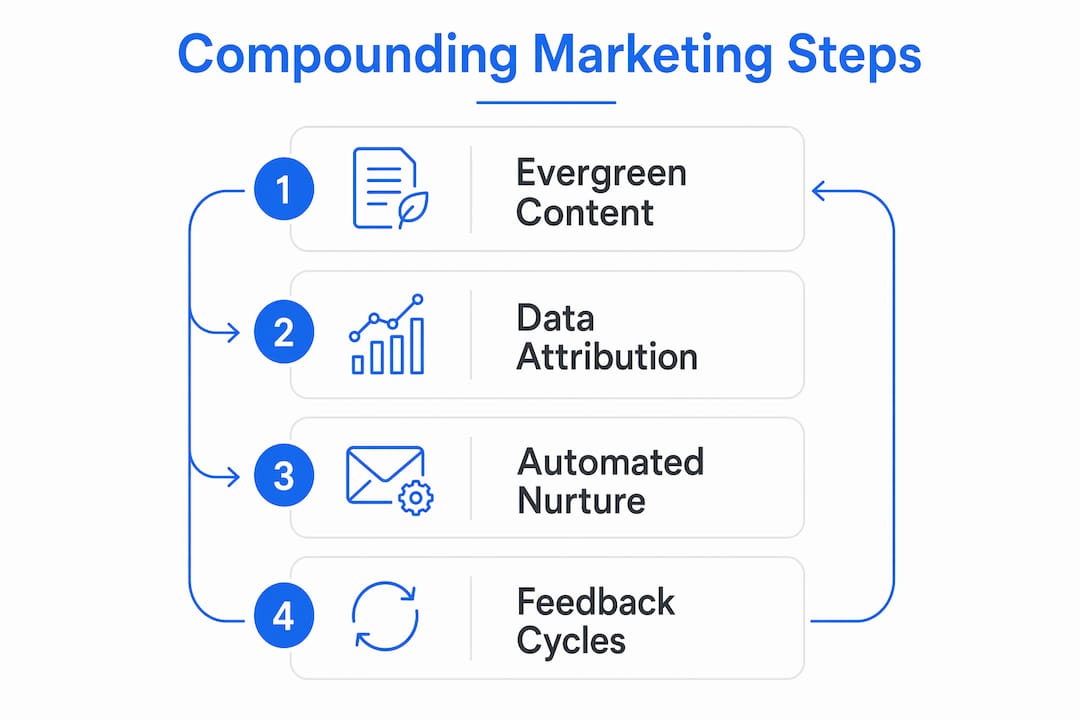
Evergreen content engine
Evergreen content is the foundation. Articles, guides, and videos that answer durable questions keep attracting traffic without ongoing spend. Even 30 pages with steady traffic can outweigh the cumulative impact of paid campaigns over time. The key is publishing content that answers questions your audience will still be asking in three years.
Data-driven attribution
Attribution tells you which assets are actually driving conversions. Without it, you are guessing which content to produce more of and which channels to invest in. Good attribution turns your marketing history into a decision-making tool rather than a report you file and forget.
Automated nurture loops
Automated email sequences, retargeting flows, and onboarding programs keep prospects moving through your funnel without requiring manual effort each cycle. These loops multiply the value of every lead your content generates.
Intelligent feedback cycles
The fourth component ties the system together. Campaign data should never be treated as disposable. Every campaign result, every open rate, and every conversion feeds back into the system to improve messaging, targeting, and content strategy. This turns temporary campaign spending into long-term intellectual property.
| Component | Primary function | Compounding mechanism |
|---|---|---|
| Evergreen content engine | Attract organic traffic | Each piece builds domain authority |
| Data-driven attribution | Identify top performers | Focuses future investment on proven assets |
| Automated nurture loops | Convert leads at scale | Improves with each iteration |
| Intelligent feedback cycles | Refine the system | Turns data into permanent learning |
One strategic theme per quarter is the recommended operating cadence for building this system. Spreading focus across too many themes prevents any single area from reaching the depth needed to compound.
Pro Tip: Pick one content pillar per quarter and produce at least five pieces around it. Depth in a single topic builds topical authority faster than breadth across many topics.
What are the most common mistakes in compounding marketing?
The biggest mistake is treating marketing sprints as a strategy rather than a supplement. A product launch campaign or a seasonal promotion is a sprint. It serves a purpose, but it does not build the system. Businesses that run sprint after sprint without building underlying assets never accumulate the base needed for compounding to kick in.
The second mistake is spreading efforts too thin. Posting on six social platforms with inconsistent messaging produces noise, not authority. Consistency in messaging and channel focus builds trust and algorithmic favor, both of which are prerequisites for sustained growth. Choosing two or three channels and owning them beats a diluted presence everywhere.
Common pitfalls that reset compounding momentum include:
- Changing your core message every quarter in response to short-term results
- Abandoning a content channel before it reaches the 60–90 day threshold where compounding effects begin to appear
- Treating campaign analytics as a one-time report rather than a permanent input to the system
- Chasing new platforms or tactics before existing assets have matured
- Measuring only short-term metrics like click-through rate while ignoring branded search growth and referral volume
Pro Tip: Before adopting any new channel or tactic, ask whether it will still be generating returns in 12 months. If the answer is no, treat it as a sprint, not a system investment.
The “shiny object” cycle is the single biggest threat to compounding growth. Resisting the temptation to chase new tactics and staying committed to a few core channels long enough to realize exponential benefits is what separates businesses that compound from those that perpetually restart.
How to implement compounding marketing growth step by step
Building a compounding marketing system requires discipline and a clear sequence. The following steps reflect how Marvingrowthpartners approaches this with growing businesses.
-
Audit your existing assets. Identify every piece of content, every email sequence, and every data set you already own. Most businesses have more reusable material than they realize. Catalog it before creating anything new.
-
Define one primary offer and one core message. Compounding requires a stable center of gravity. Your content, ads, and nurture sequences all need to point toward the same conversion goal. Fragmented messaging prevents the system from reinforcing itself.
-
Build your evergreen content base. Start with the 10–15 questions your audience asks most often. Produce thorough, well-researched answers. These become your long-term traffic assets and the entry points for your nurture loops.
-
Set up attribution from day one. You cannot improve what you cannot measure. Connect your content performance to lead and revenue data so you know which assets are pulling weight. This is the foundation of your feedback cycle.
-
Run campaigns to feed the system, not replace it. Use paid media and promotional campaigns to test messages and audiences. Feed the results back into your evergreen content and automation. Campaign data becomes permanent learning when you treat it that way.
-
Measure compounding metrics alongside short-term metrics. Track branded search volume, organic traffic growth, referral rates, and email list growth alongside cost per lead and conversion rate. The compounding metrics tell you whether the system is building. Tracking marketing ROI across both time horizons gives you the full picture.
-
Review and iterate on a quarterly cadence. At the end of each quarter, assess which content performed, which messages converted, and which channels showed growth. Use that review to set the next quarter’s single strategic theme.
Most businesses begin to see noticeable compounding effects after 60–90 days of consistent content publishing, with growth accelerating after 3–6 months. Patience is not optional. It is part of the model.
Key Takeaways
Compounding marketing growth requires building reusable assets, feeding data back into the system, and maintaining consistent focus long enough for cumulative returns to accelerate.
| Point | Details |
|---|---|
| Compounding vs. linear | Evergreen assets generate returns for years; campaigns reset to zero when spend stops. |
| Four core components | Content, attribution, automation, and feedback cycles form the learning loop that drives growth. |
| Consistency is the mechanism | Channel focus and message stability build algorithmic favor and audience trust over time. |
| Data is permanent capital | Campaign results fed back into the system become long-term intellectual property, not disposable reports. |
| Timeline expectations | Noticeable compounding effects typically appear after 60–90 days, with acceleration at 3–6 months. |
Why most marketing teams underestimate the compounding model
The hardest part of compounding marketing is not the execution. It is the patience. Teams are trained to measure success in weeks, not quarters. When a piece of content does not rank in the first month, the instinct is to abandon it and try something new. That instinct is exactly what prevents compounding from happening.
What I have seen repeatedly is that businesses with the most impressive long-term growth are not the ones with the biggest budgets. They are the ones that picked a lane, built depth in it, and resisted the urge to pivot every time a new platform appeared. Their content library grew past 200 pieces, their domain authority climbed, and their cost per lead dropped year over year. That is compounding in practice.
The role of automation and AI in this model is accelerating. Intelligent tools now help teams identify which content topics have the most compounding potential, automate nurture sequences with greater personalization, and surface attribution insights faster. But the underlying principle has not changed. The system compounds because each asset improves the next. Technology just speeds up the cycle.
Measuring the right metrics is what transforms decision-making in this model. Teams that track only short-term metrics will always feel like compounding is not working. Teams that add branded search volume, organic traffic trends, and referral growth to their dashboards start to see the curve bending upward. That visibility changes how they invest and how long they stay the course.
— Eric
How Marvingrowthpartners builds compounding marketing systems
Marvingrowthpartners works with growing businesses to replace campaign-dependent marketing with systems that build value over time. The approach combines executive-level strategy with hands-on execution, so you get a growth plan that actually gets implemented, not a slide deck that sits in a folder.

If you are ready to move from sprints to a system, the growth strategy and execution approach at Marvingrowthpartners is built around exactly this model. From evergreen content development to attribution setup and automated nurture, the work is designed to compound. Businesses that want to understand where they stand can also explore the business growth strategy consulting services to map out a clear path forward.
FAQ
What does compounding marketing growth mean in simple terms?
Compounding marketing growth means that each marketing effort builds on previous ones, creating assets that generate increasing returns over time rather than expiring when a campaign ends.
How long does it take to see compounding marketing results?
Most businesses see noticeable compounding effects after 60–90 days of consistent content publishing, with growth accelerating significantly after 3–6 months as the content library grows.
Does paid advertising contribute to compounding marketing growth?
Paid media compounds only when it is used to validate audiences, offers, and messages that then strengthen owned channels like SEO content and email. Paid campaigns run purely for short-term attention do not compound.
What is the biggest mistake businesses make with compounding marketing?
The most common mistake is treating marketing sprints as a full strategy. Without building reusable assets and feeding campaign data back into the system, businesses keep restarting from zero instead of accumulating growth.
How do you measure compounding marketing growth?
Track branded search volume, organic traffic trends, referral growth, and email list size alongside short-term metrics like cost per lead. The long-term metrics show whether the system is building cumulative value.