

Why E-Commerce Brands Need a Review Strategy in 2026
A review strategy is a structured system for collecting, displaying, and analyzing customer feedback to build trust and increase sales. Every e-commerce brand that skips this system leaves money on the table. Over 99% of American consumers read reviews before purchasing, and 93% say those reviews influence their final decision. That is not a soft preference. That is the primary filter your customers use before they ever click “Add to Cart.” Understanding why e-commerce brands need a review strategy starts with accepting that reviews are not a feature. They are the foundation of your conversion funnel.
Why e-commerce brands need a review strategy
A review strategy is the difference between a product page that converts and one that stalls. Without a deliberate system, most brands collect reviews randomly, display them poorly, and ignore the data inside them. The result is a trust gap that no amount of ad spend can close.
The importance of reviews in e-commerce goes beyond social proof. Reviews replace the in-store experience. When a shopper cannot touch a product, read a label, or ask a sales associate a question, they turn to other customers. 49% of consumers trust reviews as much as a personal recommendation from a friend. Among shoppers aged 18–34, that number rises to 91%. These are not passive readers. They are making purchase decisions based on what your previous customers wrote.

Brands that treat reviews as an afterthought are effectively outsourcing their reputation to chance. A review strategy puts that control back in your hands. It defines how you ask for reviews, when you ask, how you display them, and how you respond when things go wrong.
How do reviews impact online sales conversion rates?
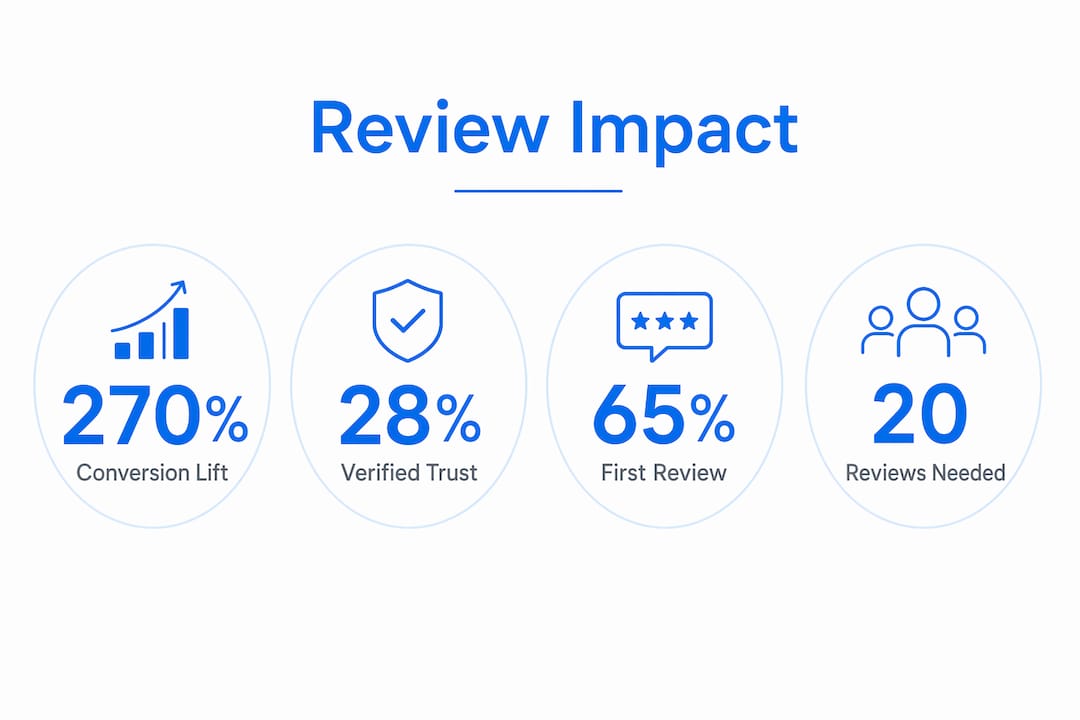
The conversion data on reviews is not subtle. Displaying reviews lifts conversion rates by 270% on average. For products priced above $100, that lift reaches 380%. These are not marginal gains. They represent the difference between a product that sells and one that sits.
The most underrated insight in review data is the impact of the very first review. Going from zero reviews to one single review produces a 65% average conversion lift. That one data point alone justifies building a review collection system from day one. Waiting until you have a large catalog or a loyal customer base is the wrong approach.
Verified-buyer badges add another layer of trust that unverified reviews cannot replicate. Verified reviews convert 28% better than unverified ones. Shoppers know the difference between a real customer and a planted comment. Platforms that display verified badges signal credibility at a glance.
Volume also sets a credibility floor. 47% of consumers will not buy from a seller with fewer than 20 reviews. That threshold is not arbitrary. It reflects the minimum sample size shoppers need to feel confident in a pattern of feedback.
Pro Tip: Prioritize getting your first 20 verified reviews on every new product before scaling paid traffic to that page. The conversion lift from those early reviews will lower your effective cost per acquisition immediately.
Why do review authenticity and volume matter for trust and SEO?
Perfect ratings are a red flag, not a selling point. 76% of consumers trust mixed reviews more than a flawless five-star average. A product with 4.3 stars and 200 reviews reads as more credible than one with 5.0 stars and 12 reviews. Shoppers have learned to spot manufactured perfection, and they discount it.
“A hybrid model combining human reviews with AI-powered summaries is the most effective way to build modern shopper trust. Brands that rely solely on star ratings miss the nuance that drives real purchase confidence.”
Volume follows a curve of diminishing returns. After roughly 100 reviews, each additional review adds less incremental conversion lift. At that point, the smarter investment is improving review quality, display format, and the depth of written feedback. Chasing raw volume past that threshold produces less ROI than refining what you already have.
Reviews also feed your SEO directly. Google uses structured review data to generate rich snippets, those star ratings that appear in search results before a shopper ever visits your page. AI platforms use product review data to generate summaries that shape a shopper’s first impression before they click. If your reviews are thin, generic, or missing schema markup, you lose that visibility entirely.
Pro Tip: Add review schema markup to your product pages using JSON-LD format. This tells Google exactly where your review data lives and increases your chances of earning rich snippet placement in search results.
The SEO value of reviews extends beyond snippets. Customer-written reviews naturally contain the long-tail search phrases your marketing team would never think to target. A shopper who writes “perfect for wide feet and narrow heels” is generating keyword content you cannot buy.
What are the best review strategies for collecting and displaying feedback?
The most reliable way to increase review volume is automation. Automated post-purchase review requests via email, SMS, and in-app notifications consistently outperform manual outreach. The timing matters. Requests sent 5–7 days after delivery, when the product experience is fresh, generate higher response rates than requests sent immediately at purchase or weeks later.
A practical collection system includes these four components:
- Triggered email sequence. Send a review request 5–7 days after confirmed delivery. Keep the email short, link directly to the review form, and show the product image to remind the customer what they bought.
- SMS follow-up. For customers who opted into text communication, a single SMS reminder 48 hours after the email increases completion rates without feeling intrusive.
- Photo and video incentives. Offer a small discount on a future purchase in exchange for a photo or video review. Visual reviews convert better than text-only feedback and give your product pages authentic media.
- Negative review response protocol. Respond to every review below four stars within 24 hours. Acknowledge the issue, offer a resolution, and keep the tone factual. Shoppers read brand responses as carefully as they read the reviews themselves.
Display placement is as important as collection. Star ratings displayed above the fold on product pages, near the price and add-to-cart button, capture attention at the moment of decision. Badges showing “Verified Buyer” and review counts displayed prominently signal credibility without requiring the shopper to scroll.
Responding to negative reviews is not damage control. It is a public demonstration of how your brand treats customers. A thoughtful response to a critical review often converts hesitant shoppers more effectively than five additional positive reviews.
How can review data improve product development and marketing?
Brands that analyze review data gain direct access to the language their customers use to describe product benefits and problems. That language is more valuable than any focus group output because it is unsolicited, specific, and written in the exact vocabulary your future customers use when searching.
The benefits of customer feedback extend well beyond reputation management:
- Marketing copy refinement. Pull the most repeated phrases from positive reviews and use them verbatim in product descriptions, ad headlines, and email subject lines. Customers trust language that sounds like other customers.
- Product issue detection. Clusters of reviews mentioning the same problem, such as sizing inconsistency or packaging damage, identify product or fulfillment issues faster than internal quality checks.
- Campaign content. Transform high-quality reviews into testimonials for paid social ads, landing pages, and email campaigns. A real customer quote outperforms a brand claim in almost every A/B test.
- Keyword discovery. Mine review text for phrases that appear in your product descriptions but not in your current SEO content. These gaps represent search traffic you are not capturing.
Review sections function as a cost-effective focus group when analyzed systematically. The data is already there. Most brands simply do not build the process to extract it. Connecting review insights to your broader data-driven marketing strategy closes the loop between what customers say and what your brand communicates. For brands building AI search visibility, review content also feeds the signals that AI platforms use to summarize and recommend products.
Key Takeaways
A review strategy is not optional for e-commerce brands. It is the most direct lever between customer trust and conversion rate.
| Point | Details |
|---|---|
| First review drives outsized lift | Going from zero to one review produces a 65% average conversion lift on product pages. |
| Verified badges matter | Verified-buyer reviews convert 28% better than unverified feedback. |
| Mixed ratings build more trust | 76% of consumers trust products with mixed reviews over perfect five-star averages. |
| Automate collection early | Triggered email and SMS requests sent 5–7 days post-delivery consistently increase review volume. |
| Reviews are marketing data | Customer review language reveals product strengths, SEO gaps, and copy that converts. |
What I’ve learned about reviews that most brands get wrong
The brands I see struggle most with reviews share one blind spot. They treat the review section as a destination rather than a data source. They set up a collection tool, watch the stars accumulate, and move on. That approach captures maybe 20% of the value reviews actually offer.
The real shift happens when you start reading reviews the way a product manager reads customer support tickets. Every cluster of similar complaints is a product brief. Every repeated compliment is a headline waiting to be written. I have watched brands cut their cost per click on paid social by rewriting ad copy using exact phrases pulled from their top-rated reviews. The creative did not change. The language did. And it worked because it sounded like a real person, not a marketing team.
The other thing I would push back on is the obsession with five-star averages. Chasing a perfect rating often leads brands to suppress or ignore critical feedback. That is exactly backwards. A 4.4-star product with 300 reviews and a few visible critical responses will outsell a 5.0-star product with 15 reviews every time. Shoppers are not looking for perfection. They are looking for honesty.
The 2026 reality is that AI-generated summaries now sit between your reviews and your potential customers. Google and other platforms are synthesizing your review content before shoppers ever reach your page. If your reviews are thin, generic, or lack specific product detail, the AI summary will be equally thin. The brands winning in search right now are the ones whose customers write detailed, specific, and varied feedback. That does not happen by accident. It happens because the brand asked the right questions at the right time.
— Eric
How Marvingrowthpartners helps brands build review-driven growth

Most e-commerce brands know reviews matter. Fewer know how to build a system that collects, analyzes, and deploys review data as a growth asset. Marvingrowthpartners works directly with e-commerce owners and marketing teams to build review strategies that connect to real business outcomes, not just star counts. The approach combines executive-level growth planning with hands-on execution, so your review system becomes part of a broader marketing engine rather than a standalone tool. If your product pages are underperforming and you suspect trust signals are part of the problem, that is exactly the kind of challenge Marvingrowthpartners is built to solve.
FAQ
What is a review strategy for e-commerce?
A review strategy is a structured system for collecting, displaying, and analyzing customer feedback to build trust and increase conversion rates. It includes automated collection, verified-buyer display, and response protocols for negative feedback.
How many reviews does a product need before shoppers trust it?
47% of consumers will not buy from a seller with fewer than 20 reviews. Reaching that threshold on each product page is the first priority before scaling paid traffic.
Do negative reviews hurt e-commerce sales?
Negative reviews, when responded to professionally, often increase trust rather than reduce it. 76% of consumers trust products with mixed ratings more than those with perfect five-star averages.
How do reviews affect SEO and AI search results?
Google uses structured review data to generate rich snippets in search results. AI platforms also synthesize review content into product summaries that influence shopper behavior before they visit a product page.
When is the best time to request a customer review?
The highest response rates come from review requests sent 5–7 days after confirmed product delivery, when the customer’s experience is fresh and they have had time to use the product.
Recommended
- The Role of Content Strategy in Brand Building – Marvin Growth Partners
- The Role of Social Media in Brand Presence for SMBs – Marvin Growth Partners
- Communities We Serve | Business Growth, SEO & AI Visibility Consulting – Marvin Growth Partners
- The Role of Data in Marketing Strategy: 2026 Guide – Marvin Growth Partners