

Build Brand Awareness Pre-Launch: Startup Guide 2026
The startups that win at launch day aren’t the ones who market hardest on day one. They’re the ones who spent the previous 90 days building a crowd that was already waiting. To build brand awareness pre-launch, you need a targeted digital presence, a defined early adopter, and a lead list that grows before you ever ship a product.
Here’s what that looks like in practice:
- Define your early adopter with specificity: job title, daily frustration, and the exact moment your product solves it.
- Launch a waitlist landing page in week one with a single, outcome-driven headline and one call to action.
- Pick 2–3 channels where your audience already spends time and show up consistently for 90 days.
- Engage communities before you pitch anything. Be helpful first, promotional never.
- Capture leads early and set up a referral program before you drive any traffic.
- Test your messaging through email responses, click-through rates, and direct conversations, not assumptions.
Why pre-launch marketing determines launch success
Most product launches fail not because the product is bad, but because the audience wasn’t ready. Gartner research found that 45% of product launches are delayed by at least one month, and delayed launches almost always mean a cold audience on arrival. Pre-launch marketing solves that by turning launch day from a cold start into a moment people have been anticipating.
Pre-launch marketing also tests your message before you commit to it publicly. You learn which positioning resonates from click-through rates and email replies, not from a boardroom deck. That feedback loop is worth more than any ad spend.
Setting clear goals before you start is what separates focused campaigns from scattered ones. Use the SMART framework: Specific, Measurable, Achievable, Relevant, and Time-bound.
- Lead capture: Aim for a specific waitlist number (e.g., 500 signups in 60 days).
- Community size: A Discord or Slack group with 200 engaged members beats 2,000 passive followers.
- Engagement metrics: Email open rates, referral share rates, and landing page conversion rates all tell you whether your message is working.
- Channel alignment: Match your goals to the 2–3 platforms where your early adopter actually spends time.
Pro Tip: Write your goals down before you build anything. A founder who can say “I need 800 waitlist signups and a 25% referral share rate by week 10” makes every content and channel decision faster.
How to build a digital presence and brand identity before launch
Your landing page is the first place your brand exists in the world. It needs to do one thing: convert a curious visitor into a waitlist signup. That means a specific, outcome-driven headline, a single above-the-fold call to action, and no navigation links pulling people away. Landing page conversion goals for pre-launch campaigns should target a range between 20% and 35%, and the headline is the highest-leverage variable.
Brand identity isn’t just a logo. It’s the combination of your visual style, your voice, and the one or two things that make you different. Lock these in before you post anything publicly.
- Visual identity: Consistent color palette, typography, and logo across every platform.
- Brand voice: Write the way your early adopter talks. If they’re engineers, skip the marketing speak.
- Core message: Name the problem, name the moment it burns worst, and show the solution. No empty adjectives.
- Social media presence: Create profiles on the 2–3 channels you’ve chosen. Fill them out completely. Post before you have a product.
Consistency across every digital touchpoint builds recognition faster than any single campaign. A visitor who sees the same message on your landing page, your LinkedIn, and your Twitter bio starts to trust that you’re real.
Pro Tip: Build a one-page brand guide before you publish anything. It should cover your hex codes, your fonts, your tone in three adjectives, and your core positioning sentence. Share it with every contractor or collaborator from day one.

How to grow and engage a community before your product launches
Community is the highest-leverage pre-launch asset most founders underinvest in. A community of 300 genuinely engaged people will drive more signups on launch day than a cold email list of 3,000. The key is showing up where your audience already gathers, not trying to pull them somewhere new.
Building in public does more than generate social proof. It emotionally engages early adopters who become advocates and referrers, because they feel invested in your success. Share real milestones, real numbers, and real setbacks. The “build in public” subculture on X/Twitter and IndieHackers rewards genuine content with reposts and replies that no ad budget can replicate.
- Choose your platforms: Reddit subreddits, niche Slack groups, Discord servers, LinkedIn communities, or IndieHackers, depending on where your early adopter actually hangs out.
- Lead with value: Answer questions, share useful resources, and correct misinformation before you ever mention your product.
- Two-way communication: Ask your community what they think. Run polls. Reply to every comment in the first 30 days.
- Soft CTAs only: Mention your waitlist in your bio and pinned post. Don’t pitch in every thread.
Pro Tip: Spend two weeks reading and commenting in your target communities before you post anything about your product. You’ll learn the culture, earn credibility, and avoid the rookie mistake of leading with a promo.

Creating content and advertising that increase pre-launch visibility
Content is how you stay visible between now and launch day. The format that consistently outperforms everything else in pre-launch is video. Video content drives waitlist signups at significantly higher rates than static content, and a 60-second product demo or founder story is achievable without a production budget.
A consistent publishing schedule matters more than any single piece of content. Pick 2–3 platforms and post 3–5 times per week on each for the full pre-launch period. Spreading across more channels than you can sustain consistently is one of the most common ways pre-launch momentum dies.
- Content types that work: Product demos, founder story videos, explainer posts, behind-the-scenes progress updates, and customer pain point threads.
- Paid advertising: Use retargeting to reach people who’ve already visited your landing page. They’re far more likely to convert than cold audiences.
- Influencer collaborations: Mid-tier creators with audiences that match your early adopter profile often drive more targeted signups than large accounts with broad followings.
- PR outreach: Pitch journalists and podcast hosts 4–6 weeks before launch with an embargoed angle. A single feature in a relevant publication can drive hundreds of signups.
For lead generation and branding to compound, your content and your paid media need to point at the same message. Fragmented campaigns split attention and dilute recognition.
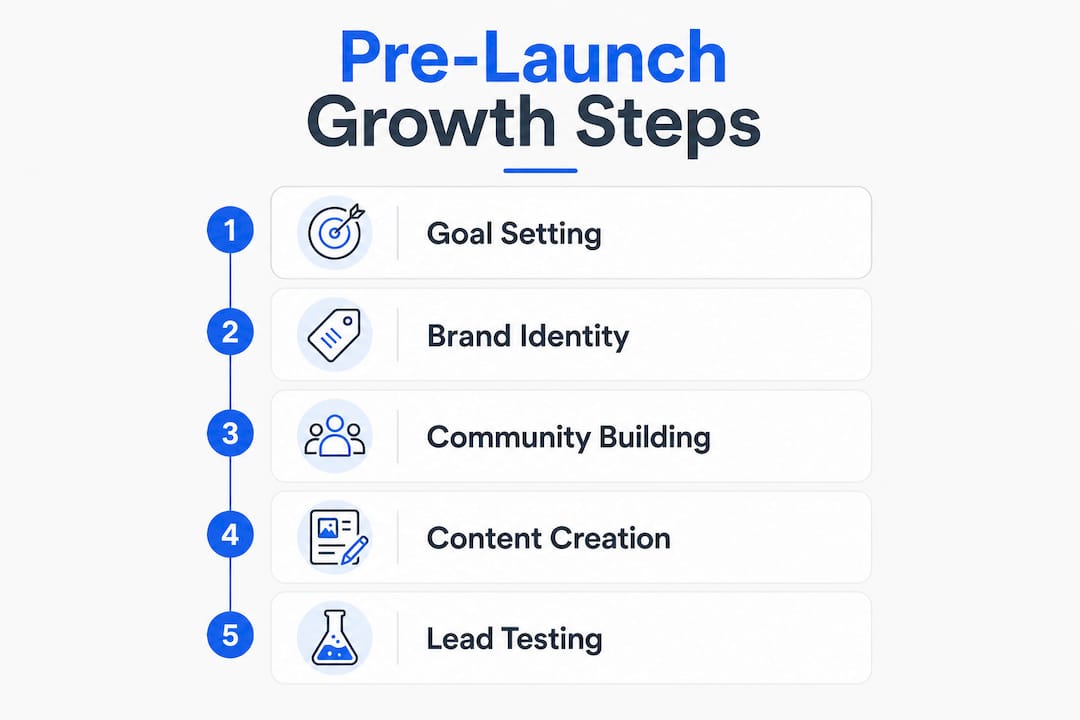
How to build a lead database and test your messaging before launch
Your waitlist is your most valuable pre-launch asset, but only if you set it up before you drive any traffic. Launching a referral program before your first signup means every early subscriber has the chance to become a referrer. Referral conversion rates typically range between 10% and 25%, depending on program structure and execution, and the mechanics are straightforward: a unique link per subscriber, a position counter, and milestone rewards.
Testing your messaging isn’t a one-time exercise. It’s a weekly habit during pre-launch.
- Soft CTAs: Use educational content and community posts to gauge interest without aggressive selling. Watch which topics get replies and which get ignored.
- Email sequences: Build a 3–4 email nurture sequence for your waitlist. Track open rates and click-through rates on each email to identify which messages resonate.
- Segmentation: Tag leads by source (referral, organic, paid) and by engagement level. Your most engaged subscribers should get early access first.
- Direct conversations: Message your first 50 signups personally. Ask what problem they’re trying to solve. Their words become your best copy.
Soft CTAs and educational content consistently outperform aggressive pre-launch pitches. Founders who lead with industry pain points and hold the product pitch until trust is established build stronger early communities.
How AI and Answer Engine Optimization give you an early visibility edge
Discovery is shifting. Brands not recognized as trusted entities in AI search results risk invisibility when buyers ask ChatGPT, Perplexity, or Google’s AI Overviews for recommendations. Getting cited by AI tools before you launch puts you in front of buyers who haven’t even started searching yet.
Answer Engine Optimization (AEO) means structuring your content so AI tools can parse and cite it easily. Lead each section with a direct answer. Use H2 and H3 headings phrased as real questions. Include FAQ blocks. Add schema markup for FAQ and HowTo content. These aren’t advanced tactics; they’re table stakes for any content you publish in 2026.
- Explicit definitions: State what your product does, who it’s for, and what problem it solves in the first two sentences of every key page.
- Entity authority: Use your brand name consistently across every external profile, including Google Business Profile, LinkedIn, and Crunchbase. AI systems build knowledge graphs from these signals.
- Authoritative citations: Earn mentions in publications that AI tools already cite. Digital PR isn’t just a vanity play; it feeds the AI recommendation layer directly.
- Track AI citations: Check ChatGPT, Perplexity, and Claude monthly for your priority queries. Note which brands appear and when you start showing up.
Multi-channel brand visibility compounds recognition across Google, AI tools, social platforms, and communities simultaneously. Brands that treat these as connected pieces rather than separate projects see the biggest gains. For a deeper look at how this works, Marvingrowthpartners covers AI search optimization in detail.
Statistic callout: A majority of AI users trust results from known brands more, which means brand recognition directly influences whether AI tools recommend you at all.
Starting pre-orders or early signups
Pre-orders and early signups do two things at once: they validate demand and they create a financial or psychological commitment that makes buyers far more likely to follow through on launch day. The mechanics matter. Put the signup or pre-order on a page with a single CTA, visible social proof if you have it, and a referral incentive on the confirmation screen.
Two patterns work well. A rolling beta invites 20–50 users per week from your waitlist as you build capacity, generating steady feedback and rewarding top referrers first. A big-bang launch holds everyone on the waitlist until launch day, maximizing momentum on platforms like Product Hunt. Most teams blend both: rolling access for top referrers, full launch for everyone else.
Early signups also give you a feedback channel before you’re fully live. Survey your first 100 signups on the problem they’re trying to solve. Their language shapes your final positioning.
Organizing pre-launch events and webinars
A live event before launch does something no landing page can: it puts real faces and voices behind your brand. A 45-minute webinar addressing a genuine pain point your early adopter faces, with no product pitch until the final five minutes, builds more trust than a month of social posts.
Keep the format simple. A founder-led Q&A, a panel with two or three practitioners in your space, or a live product walkthrough for waitlist members all work. Promote the event through your existing waitlist, your community channels, and a targeted LinkedIn or Meta ad to a lookalike audience built from your current signups.
Record everything. A single live event produces a YouTube video, three short clips for social, a blog post summarizing the key questions, and an email to your waitlist with the replay link. That’s five pieces of content from one hour of work.
Measuring and analyzing your pre-launch campaign performance
You can’t fix what you don’t track. Set up a weekly reporting rhythm from day one of your pre-launch period, not the week before launch.
The metrics that matter most:
| Metric | Target range | What it tells you |
|---|---|---|
| Landing page conversion | aimed to be effective and measurable | Headline and offer fit |
| Referral share rate | varies based on confirmation page and email quality | Confirmation page and email quality |
| Referral conversion | depends on landing page strength | Landing page strength |
| Email open rate | monitored to assess subject lines and sender reputation | Subject lines and sender reputation |
| Activation intent score | Track over time | Whether you’re building the right thing |
If your landing page conversion is below 20%, the headline is the first thing to fix. If email opens fall below 35%, check your sender domain setup before you touch the copy. If referral share rate is low, the post-signup experience needs work, starting with the confirmation page.
Track branded search volume monthly. Rising branded search means people are seeking you out by name, which is the compounded result of every impression across every channel. That signal tells you the pre-launch campaign is working before you ever see a sales number.
Key Takeaways
Effective pre-launch brand awareness requires a focused digital presence, consistent community engagement, and measurable goals set before you publish a single piece of content.
| Point | Details |
|---|---|
| Set goals before you build | Define specific waitlist targets, engagement metrics, and channel focus before launching any campaign. |
| Video outperforms static content | Video drives waitlist signups at significantly higher rates; prioritize a short demo or founder story early. |
| Referral programs need early setup | Launch your referral mechanic before driving traffic so every early signup can become a referrer. |
| AEO visibility starts pre-launch | Structure content with explicit definitions and Q&A formatting so AI tools can cite your brand from day one. |
| Track the right metrics weekly | Monitor landing page conversion (target 20–35%) and email open rates (target 35–60%) to catch problems early. |
Ready to turn your pre-launch into a growth system?
Marvingrowthpartners works with founders and growth teams to build the kind of pre-launch systems that produce real waitlist numbers, not just activity. The approach combines executive-level strategy with hands-on execution, so you get a plan that actually gets built, not one that sits in a slide deck.
If you’re preparing for a launch and want a clear picture of where your visibility stands right now, start with a visibility assessment to identify the gaps before they cost you momentum on launch day.