

What Is a Launch Marketing Strategy? SMB Guide
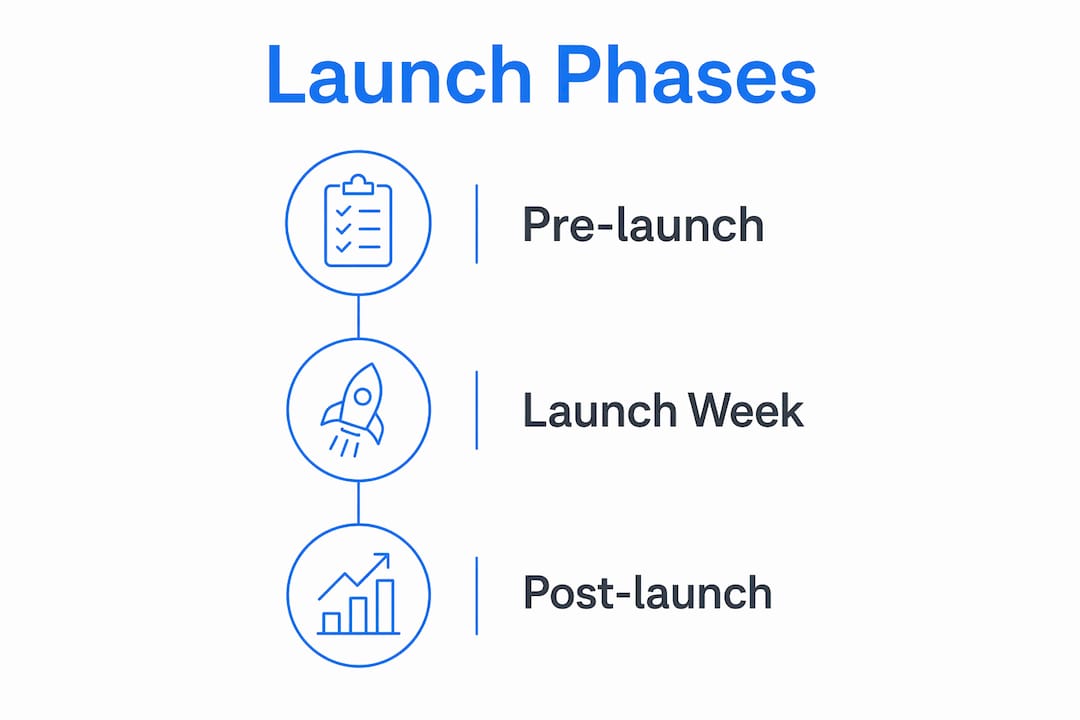
A launch marketing strategy is defined as a phased, coordinated plan to introduce a new product or service to market with maximum impact and measurable results. The strategy covers three distinct phases: pre-launch, launch week, and post-launch. Each phase has specific goals, channels, and tactics. Without this structure, even well-funded teams waste budget on scattered activity that fails to build real momentum. The most effective product launch strategies combine clear SMART goals, cross-functional coordination, and focused multi-channel execution within a defined timeline.
What are the essential phases of a launch marketing strategy?
A successful product launch typically spans 8–16 weeks, divided into three phases: pre-launch (6–12 weeks), launch week (1 week), and post-launch (2–12 weeks). That timeline is not arbitrary. Each phase builds on the last, and compressing any one of them weakens the entire launch.
Pre-launch: building the foundation
Pre-launch is where the real work happens. This phase covers audience research, positioning, messaging development, and channel setup. You validate your core offer with a small segment before committing full budget. You also grow your waitlist, build email sequences, and brief internal teams. Skipping validation at this stage is the single most common reason launches underperform.

| Phase | Duration | Primary Goal |
|---|---|---|
| Pre-launch | 6–12 weeks | Audience building, validation, messaging |
| Launch week | 1 week | Synchronized multi-channel activation |
| Post-launch | 2–12 weeks | Optimization, nurture, feedback loops |
Launch week: synchronized activation
Launch week is a coordinated drop across all channels within the same short window. Owned media (email, website, social profiles), earned media (PR, influencer mentions), and paid media (ads) all go live together. The goal is concentrated attention, not a slow trickle. Teams that stagger their channel activation lose the compounding effect of simultaneous exposure.
Pro Tip: During the first 24–48 hours of launch, assign one team member to monitor and respond to audience engagement within 30 minutes. Early responsiveness signals credibility and drives algorithm-friendly engagement on social platforms.
Post-launch: sustaining momentum
Post-launch is the phase most SMBs neglect. Post-launch content such as reviews, tutorials, and case studies extends momentum well beyond the initial announcement. Optimization happens within the first 30 days, when you have real performance data to act on. This phase is where you convert launch awareness into actual customers.
Which marketing channels drive effective product launches?
The most effective launch marketing plan concentrates resources on 2–3 high-impact channels rather than spreading thin across every platform. Consumer product launches often split spend at roughly 80% on Meta ads and 20% on Google Search. That ratio reflects where purchase intent and discovery overlap for most consumer audiences.
Choosing the right channels depends on where your buyers already spend time. A B2B SaaS product may prioritize LinkedIn and email over Meta. A direct-to-consumer physical product may lean heavily on Instagram and TikTok. The channel mix follows the audience, not the other way around.
The most effective tactics for launch week include:
- Email sequences: A pre-launch teaser, a launch day announcement, and a follow-up within 72 hours form the minimum viable email cadence.
- Paid social: Meta and Google ads drive awareness and retargeting simultaneously during the launch window.
- PR and earned media: A press release timed to launch day, combined with influencer seeding done 2–3 weeks earlier, creates organic amplification.
- User-generated content: UGC sustains post-launch momentum better than brand-led content because it carries social proof.
- Content marketing: Blog posts, how-to videos, and comparison guides support SEO and keep the product visible after launch week ends.
A coordinated multi-channel drop activating owned, earned, and paid media simultaneously creates a compounding effect. Each channel reinforces the others, making the launch feel larger than any single channel could deliver alone.
Pro Tip: Build a 30-day post-launch content calendar before launch day. Teams that plan post-launch content in advance publish consistently. Teams that plan it after launch day typically go quiet within two weeks.
How to define goals and coordinate your team for launch
SMART goals set before campaign design prevent wasted effort and clarify what success actually looks like. A goal like “generate 500 trial signups in 30 days” is specific enough to drive channel and creative decisions. A goal like “increase brand awareness” is not. The difference between the two determines whether your team makes decisions or just makes activity.
Setting goals first also forces alignment across departments. When product, marketing, sales, and leadership all agree on the same success metric, channel and budget decisions become much easier to defend. Without that shared definition, each team optimizes for a different outcome.
A launch is fundamentally a coordination problem, not just a creative one. The operational tools that make coordination work include:
- A shared positioning brief: One document that defines the product’s core value, target buyer, key messages, and proof points. Every team works from the same source.
- A RACI matrix: Clarifies who is Responsible, Accountable, Consulted, and Informed for every launch task. Without it, teams operate in silos and create inconsistent messaging.
- Daily short syncs during launch week: A 15-minute daily check-in keeps the team agile and surfaces blockers before they become delays.
- Internal enablement briefs: Sales and Customer Success teams need battle-tested one-page briefs before launch day. Frontline teams that understand the product’s value proposition sell it more confidently.
Pro Tip: Send the internal enablement brief to your Sales and Customer Success teams at least two weeks before launch. That window gives them time to ask questions, practice their messaging, and flag gaps before customers start asking.
Aligning your marketing with business goals before launch is the step most SMBs skip. They jump to channel selection and creative before they have agreed on what the launch is supposed to achieve. That sequence produces beautiful campaigns with unclear results.
Common pitfalls in product launch strategies
Rushing the launch is the most damaging mistake a team can make. A 6-week minimum timeline is realistic for mid-size campaigns. Accelerated launches miss key audience-building steps, which weakens launch day momentum and reduces the return on every dollar spent.
Inconsistent messaging across channels erodes audience trust faster than almost any other mistake. When your email says one thing and your ads say another, buyers lose confidence in the product before they even try it. Unified messaging adapted per channel builds credibility without sacrificing channel-specific tone.
The most common pitfalls to avoid:
- Starting too late: A 6-week minimum is the floor, not the target. Eight to twelve weeks gives you time to build an audience before launch day.
- Neglecting the post-launch phase: Most SMBs go quiet after launch week. That silence kills momentum right when early adopters are making referral decisions.
- Spreading across too many channels: Five channels with thin coverage perform worse than two channels with deep, consistent presence.
- Skipping internal enablement: If your Sales team cannot explain the product clearly on launch day, no amount of advertising will compensate.
- Treating launch as a one-day event: A launch is a campaign arc, not a single moment. The announcement is the beginning, not the peak.
Building a custom marketing strategy before launch day gives you a decision framework for every channel, budget, and messaging question that comes up during execution. Teams without that framework improvise under pressure, and improvised decisions during launch week are expensive.
Key Takeaways
A launch marketing strategy succeeds when it combines SMART goals, phased execution across 8–16 weeks, and tight cross-functional coordination before a single ad goes live.
| Point | Details |
|---|---|
| Three-phase structure | Plan pre-launch, launch week, and post-launch as distinct phases with separate goals. |
| Focus your channels | Concentrate on 2–3 high-impact channels rather than spreading budget across every platform. |
| Set SMART goals first | Define specific, measurable success metrics before making any channel or creative decisions. |
| Coordinate internally | Use a RACI matrix and one-page briefs to align product, marketing, sales, and leadership. |
| Plan post-launch content | Build a 30-day post-launch content calendar before launch day to sustain momentum. |
What I’ve learned from running product launches
The most common mistake I see from startups and SMBs is treating the launch as a creative project with a deadline. They focus almost entirely on the announcement asset: the video, the landing page, the ad creative. Then launch day arrives and the internal team is confused, the Sales team is unprepared, and the post-launch calendar is blank.
The launches that actually work are run like operations. There is a living document that gets updated daily. There are clear owners for every task. There are short daily syncs during launch week that surface problems before they compound. The creative matters, but it is the coordination that determines whether the creative reaches the right people at the right time.
I have also seen what happens when teams skip pre-launch audience building. They launch to silence. A small, warm audience of 500 people who already want the product will outperform a cold audience of 50,000 every time. Building that warm audience during the pre-launch phase is the highest-leverage activity in the entire strategy.
The other thing I push hard on is channel focus. Every founder wants to be everywhere. The teams that win pick two channels, go deep, and dominate them during launch week. Thin coverage across five channels produces noise. Deep coverage on two channels produces results.
— Eric
How Marvingrowthpartners helps SMBs launch with confidence
Marvingrowthpartners works with startups and SMBs that need executive-level thinking without the overhead of a full-time internal team. The firm builds launch strategies grounded in real business goals, not recycled playbooks.

If you are preparing to bring a new product or service to market, Marvingrowthpartners can help you define your goals, align your team, and build a phased execution plan that holds up under launch-week pressure. The firm’s growth strategy consulting covers everything from positioning and channel selection to internal enablement and post-launch optimization. You can also review the firm’s full approach to see how strategy and execution work together in practice.
FAQ
What is a launch marketing strategy?
A launch marketing strategy is a phased plan to introduce a new product or service to market, covering pre-launch, launch week, and post-launch activities. It defines goals, channels, messaging, and team responsibilities before the first campaign goes live.
How long should a product launch strategy take?
A realistic launch timeline spans 8–16 weeks, with pre-launch covering 6–12 weeks, launch week lasting one week, and post-launch running 2–12 weeks. A 6-week minimum applies even for smaller campaigns.
What channels work best for a product launch?
The most effective approach focuses on 2–3 high-impact channels matched to your audience. Consumer product launches often allocate roughly 80% of spend to Meta ads and 20% to Google Search, then layer in email and earned media.
Why do product launches fail?
The most common causes are starting too late, inconsistent messaging across channels, neglecting the post-launch phase, and failing to brief internal teams before launch day. Each of these is a coordination failure, not a creative one.
What is a RACI matrix and why does it matter for launches?
A RACI matrix defines who is Responsible, Accountable, Consulted, and Informed for every launch task. It prevents teams from working in silos and keeps messaging consistent across departments during a high-pressure launch window.
Recommended
- Marketing Strategy Types for SMBs: 2026 Growth Guide – Marvin Growth Partners
- Build a Custom Marketing Strategy for Your SMB in 2026 – Marvin Growth Partners
- Why Bootstrapped Marketing Strategies Work for SMBs – Marvin Growth Partners
- Marketing Funnel for SMBs: A Practical Growth Guide – Marvin Growth Partners