

What Is a Go-to-Market Strategy? A 2026 Guide
A go-to-market strategy is a targeted, one-time plan that defines how a company introduces a new product or service to its customers with precision and cross-functional alignment. Unlike a business plan or a long-term marketing strategy, a GTM plan focuses on a single launch event or market entry. It answers two questions: where will you reach your customers, and how will you convert them? Every entrepreneur and marketing professional who skips this step pays for it in wasted budget and missed timing.
What is a go-to-market strategy built from?
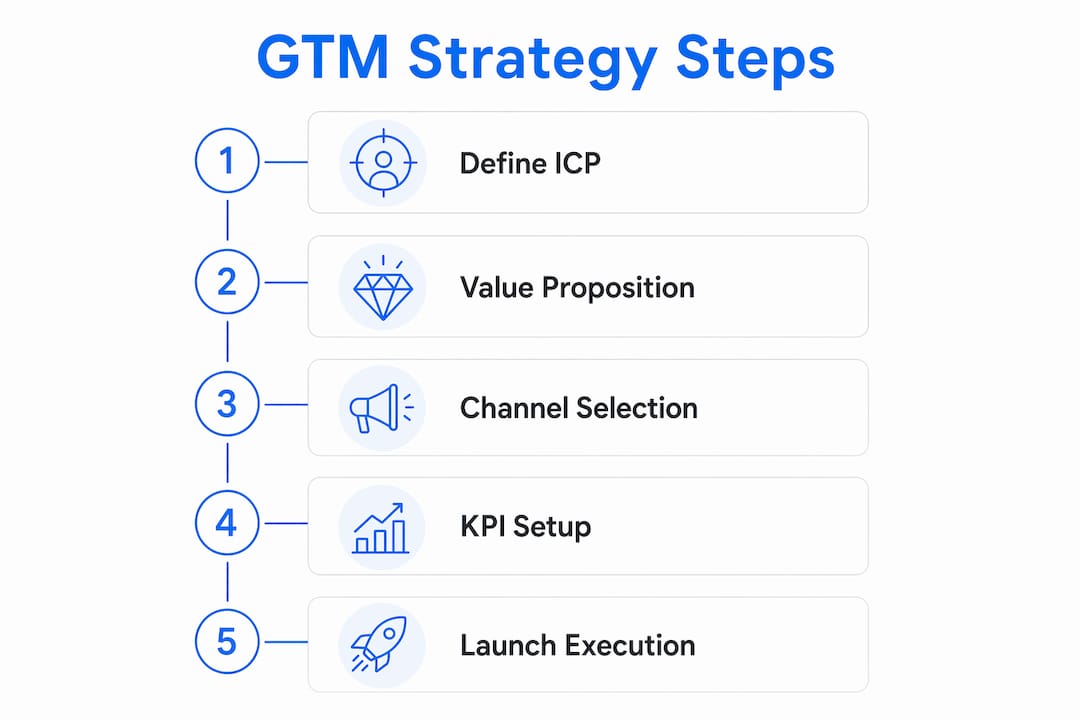
A GTM strategy is built from five core components: customer definition, value proposition, pricing, distribution channels, and measurement. Each component connects to the others. Weak customer definition, for example, breaks your messaging, your channel selection, and your sales motion all at once.
Here is what each component requires:
- Target customer definition. A precise Ideal Customer Profile (ICP) is so specific that salespeople can disqualify leads without manager approval. The ICP targets the segment where you win fastest, retain longest, and expand most predictably.
- Value proposition and positioning. Positioning transforms a value proposition from a marketing claim into a believable strategic narrative that resonates with buyers. Without positioning, your value prop is just a tagline.
- Distribution channels and sales motions. Channel selection determines how your product reaches buyers. This is a strategic decision, not a brainstorm.
- Pricing strategy. Pricing signals value and filters your audience. A misaligned price point undermines even a strong product.
- KPIs and feedback loops. Measurement is not optional. You need defined metrics before launch so you can evaluate performance objectively after it.
Pro Tip: Build your ICP before you write a single line of messaging. Every word in your GTM plan should reflect the specific person you are trying to reach, not a general market segment.
Understanding the buyer journey and buying center before launch helps you map objections and internal workflows early. That pre-launch mapping is the core mechanism for risk reduction in any GTM plan.

How does a GTM strategy differ from a marketing or business plan?
A go-to-market strategy is a tactical, time-bound launch plan. A marketing strategy is a long-term program for brand building and demand generation. A business plan is a financial and operational blueprint for the entire company. These three documents serve different purposes and operate on different timescales.
| Document | Scope | Timeframe | Primary question |
|---|---|---|---|
| Go-to-market strategy | Single product or market entry | Weeks to months | How do we launch this, to whom, and through which channels? |
| Marketing strategy | Brand, demand, and retention | 1–3 years | How do we grow awareness and pipeline over time? |
| Business plan | Full company operations | 3–5 years | How does the business sustain itself financially? |
Salesforce defines a GTM strategy as a targeted action plan incorporating the 4 Ps: Product, Price, Place, and Promotion, applied specifically to a new launch. That specificity is what separates it from the broader documents above.
A common mistake is treating a GTM plan as a condensed version of a marketing strategy. They are not the same document at different scales. A GTM plan has a defined end point. A marketing strategy does not.
Pro Tip: If your GTM document does not have a launch deadline and a defined set of success metrics, it is probably a marketing strategy in disguise. Add both before you proceed.
What advanced methods are shaping GTM strategies in 2026?
Modern GTM strategies use AI agents, predictive analytics, and neuromarketing techniques to sharpen segmentation and messaging. These tools are not experimental. They are now standard practice for teams that want to reduce launch risk and improve conversion rates before spending at scale.
The most impactful advances include:
- AI-driven segmentation. Predictive analytics segments audiences by demographics, behaviors, psychographics, and purchase readiness. This level of granularity was not accessible to most startups five years ago. Now tools built on large language models make it standard.
- Neuromarketing and A/B testing. Teams use neuromarketing principles alongside A/B testing for messaging to measure which value proposition framing generates the strongest emotional response before committing to a full campaign.
- Mini-launch testing. A mini-launch before full market entry lets teams collect real performance data at low cost. It tests lead funnels, customer service workflows, and product messaging under real conditions. The insights from a mini-launch are worth more than any amount of pre-launch research.
- Data-driven channel validation. Rather than selecting channels based on assumptions, teams now validate channel fit with small paid tests before allocating full budgets.
The role of data in marketing strategy has expanded significantly. Entrepreneurs who treat GTM as a data problem, not just a creative one, consistently outperform those who rely on intuition alone.
What are the most common GTM pitfalls, and how do you avoid them?
Most GTM failures trace back to a small set of repeatable mistakes. Knowing them in advance is the fastest way to avoid them.
- Skipping ICP definition. Launching without a precise ICP wastes budget on unqualified leads. A detailed ICP enables sales teams to filter leads efficiently, maximizing qualified pipeline and reducing wasted effort.
- Opening too many channels at once. Trying multiple channels simultaneously stretches budgets and dilutes impact. Focus on one or two validated channels first.
- Treating GTM as a creative exercise. A GTM plan is a disciplined framework, not a brainstorm. Positioning must make the value proposition credible, not just memorable.
- Ignoring cross-departmental alignment. Successful GTM strategies align product, marketing, sales, and customer success around a shared, measurable objective. Without that alignment, execution breaks down even when the plan is solid.
- Skipping the mini-launch. Launching at full scale without a test phase removes your ability to course-correct cheaply. A mini-launch is not optional for teams that care about efficiency.
Pro Tip: Run a pre-mortem before your launch. Ask your team: “If this GTM plan fails in 90 days, what was the most likely cause?” The answers will surface your real risks faster than any planning document.
How to create a go-to-market strategy: steps and examples
Building a GTM plan follows a structured process. Zendesk outlines an 11-step GTM framework that covers everything from deadline setting to post-launch optimization. The steps below reflect that framework with practical context added.
- Set a hard launch deadline. A deadline forces prioritization. Without one, GTM planning expands indefinitely.
- Define your value proposition. State the specific problem you solve, for whom, and why your solution is better than the alternatives.
- Build your ICP. Include firmographics, job titles, pain points, buying triggers, and disqualifying factors.
- Select your pricing model. Align price to perceived value and competitive positioning, not just cost-plus math.
- Choose your distribution channels. Pick one or two channels based on where your ICP already spends time and attention.
- Develop your messaging framework. Write distinct messages for each stage of the buyer journey, from awareness to decision.
- Define your KPIs. Set specific metrics for pipeline, conversion rate, customer acquisition cost, and retention.
- Align your internal teams. Brief product, marketing, sales, and customer success on their roles and shared objectives.
- Update your sales playbook. Equip your sales team with objection handling, competitive positioning, and qualification criteria.
- Run a mini-launch. Test your funnel, messaging, and support workflows with a limited audience before full rollout.
- Analyze and optimize. Review KPI performance post-mini-launch and adjust before scaling.
A practical example: a B2B SaaS startup entering the project management space would define its ICP as operations managers at companies with 50–200 employees, select LinkedIn and outbound email as its two channels, and run a mini-launch to 200 prospects before investing in paid acquisition. That sequence reduces risk and produces real data before the full budget is committed.
For teams building their first plan, a custom marketing strategy framework that incorporates KPI measurement and mini-launch checkpoints is the most reliable starting point.
| GTM stage | Key action | Success metric |
|---|---|---|
| Pre-launch | ICP definition and channel selection | ICP document approved by sales and marketing |
| Mini-launch | Test funnel with limited audience | Lead-to-meeting conversion rate |
| Full launch | Scale validated channels | Customer acquisition cost vs. target |
| Post-launch | Optimize based on KPI data | Retention rate at 90 days |
Key Takeaways
A go-to-market strategy succeeds when it combines a precise ICP, a credible value proposition, focused channel selection, cross-functional alignment, and a mini-launch that tests the plan before full investment.
| Point | Details |
|---|---|
| GTM is time-bound | A GTM plan covers a single launch, not ongoing marketing activity. |
| ICP precision drives efficiency | A specific ICP lets sales teams disqualify leads without manager approval. |
| Channel focus beats channel volume | One or two validated channels outperform five untested ones every time. |
| Mini-launches reduce risk | Testing with a limited audience before full rollout produces real data cheaply. |
| Alignment is non-negotiable | Product, marketing, sales, and customer success must share one measurable objective. |
What I have learned from watching GTM plans succeed and fail
Most GTM failures I have seen share one trait: the team skipped the hard thinking early and paid for it at launch. The ICP was vague. The channels were chosen by committee. The value proposition was written to please internal stakeholders, not actual buyers.
The teams that get it right treat GTM planning as a constraint exercise. They force themselves to pick one customer segment, one primary channel, and one measurable outcome. That discipline feels uncomfortable before launch. It feels like a competitive advantage after it.
The mini-launch concept is underused by entrepreneurs who are eager to scale. Running a controlled test with a small audience is not a sign of low ambition. It is the fastest way to find out what your GTM plan gets wrong before those mistakes cost real money. I have seen companies save months of wasted spend by running a two-week mini-launch that revealed a messaging problem no amount of internal review had caught.
Cross-departmental alignment is the piece most articles mention and most teams ignore. A GTM plan that lives only in the marketing department is not a GTM plan. It is a campaign brief. Real alignment means your customer success team knows the launch date, your sales team has updated qualification criteria, and your product team has signed off on the messaging. Without that, you are launching with one hand tied behind your back.
— Eric
How Marvingrowthpartners approaches GTM planning for growing companies
Marvingrowthpartners works with entrepreneurs and marketing teams who need a GTM plan built on real market intelligence, not recycled templates. The approach combines executive-level strategy with hands-on execution, covering ICP development, channel selection, KPI frameworks, and mini-launch design.
For companies that need efficiency without the overhead of a full-time internal team, Marvingrowthpartners delivers a structured GTM process tied to measurable outcomes. Every engagement is built around the specific growth stage and market conditions of the client, not a generic playbook. If you are preparing a product launch or entering a new market, the GTM planning and execution services at Marvingrowthpartners give you the framework and the team to execute it with confidence.
FAQ
What is a go-to-market strategy in simple terms?
A go-to-market strategy is a focused plan for launching a specific product or entering a new market. It defines your target customer, your value proposition, your channels, and your success metrics.
How is a GTM strategy different from a marketing plan?
A GTM strategy is time-bound and tied to a single launch. A marketing plan covers ongoing brand building and demand generation over one to three years.
What are the key steps in a go-to-market strategy?
The core steps include defining your ICP, setting your value proposition, selecting channels, establishing KPIs, aligning internal teams, and running a mini-launch before full rollout.
Why is the importance of a go-to-market strategy so high for startups?
A GTM strategy reduces launch risk by mapping the buyer journey, identifying objections, and testing messaging before full investment. Without it, startups spend budget on unvalidated assumptions.
What makes a go-to-market strategy example effective?
Effective GTM examples share three traits: a precise ICP, a focused channel strategy, and a mini-launch that generates real performance data before scaling.
Recommended
- Marketing Strategy Types for SMBs: 2026 Growth Guide – Marvin Growth Partners
- What Is Integrated Marketing Strategy: A 2026 Guide – Marvin Growth Partners
- Build a Custom Marketing Strategy for Your SMB in 2026 – Marvin Growth Partners
- Stage-Based Growth Strategy Guide for SMEs – Marvin Growth Partners