

Why Niche Marketing Helps Local Entrepreneurs Win
Niche marketing is the practice of targeting a specific, well-defined group of customers to maximize marketing effectiveness and business growth. For local entrepreneurs, this focus is not a limitation. It is a competitive advantage. Niche-focused websites see 30% higher engagement compared to broader sites because targeted messaging speaks directly to what customers actually need. That gap in engagement translates directly into more leads, more sales, and stronger word-of-mouth. Understanding why niche marketing helps local entrepreneurs starts with recognizing that a smaller, better-defined audience almost always outperforms a large, indifferent one.
Why niche marketing helps local entrepreneurs outcompete larger rivals
Broad marketing spreads your budget thin and puts you in direct competition with businesses that have far more resources. Niche marketing sidesteps that problem entirely. Targeting a defined niche reduces wasted ad spend and lets small businesses compete with larger corporations without needing massive marketing budgets. That is not a minor efficiency gain. It is the difference between burning cash on generic Google Ads and running a focused campaign that converts.
Local entrepreneurs who niche down also gain a positioning advantage that money alone cannot buy. When your messaging speaks to a specific person with a specific problem, that person feels understood. A general contractor who markets to “homeowners” competes with everyone. A contractor who markets to “historic home restoration in [city name]” owns a category. The benefits of niche marketing show up fastest in how much less you spend to acquire each customer.

The financial case is equally strong on the revenue side. Niche brands command premium pricing because customers pay more for solutions tailored to their exact needs, which results in higher lifetime value per customer. Specialists charge more than generalists. That pricing power compounds over time as your reputation grows within the niche.
Pro Tip: Before you commit to a niche, run a short paid ad test or a landing page with a sign-up form. Real demand shows up in clicks and opt-ins, not in your gut feeling.
Three financial benefits of focused marketing for small businesses
- Lower cost per acquisition. Targeted ads reach people already looking for your specific solution, so fewer impressions are wasted.
- Higher conversion rates. Messaging that matches a buyer’s exact situation converts at a higher rate than generic copy.
- Stronger pricing power. Customers who see you as a specialist pay more and negotiate less. This is one of the clearest advantages of focused marketing for entrepreneurs working with limited budgets.
How does niche marketing build customer loyalty in local markets?
Loyalty is built on relevance. When a business consistently speaks to the specific needs of a defined group, customers stop shopping around. They return because no one else understands their situation as well as you do.
Building quality relationships with a smaller audience enhances brand advocacy and word-of-mouth impact far more than broad market advertising. Word-of-mouth inside a tight community travels fast and carries weight. A recommendation from a trusted peer in a niche group is worth more than any paid ad.
“Niche expertise positions a business as a trusted authority, which is more defensible than competing on price in broad markets. Once customers see you as the go-to specialist, they refer others who share their exact profile, and your marketing practically runs itself.”
Niche businesses also benefit from a feedback loop that broad businesses rarely experience. Because your customers share similar needs, the feedback you collect from one customer often applies to many others. You refine your product or service faster, and your messaging gets sharper with every iteration. That continuous improvement is one of the most underrated niche strategies for entrepreneurs building long-term businesses.
What loyalty looks like in practice
- Repeat purchases without prompting. Customers who feel understood come back without needing a discount or a reminder campaign.
- Organic referrals. Satisfied niche customers refer friends who share the same profile, which means your new leads arrive pre-qualified.
- Community authority. Over time, your business becomes the recognized name in the niche, which makes every future marketing effort cheaper and more effective.
Niche marketing vs. local marketing: what is the difference?
These two terms get used interchangeably, but they describe different strategies. Understanding the distinction helps you use both more effectively.
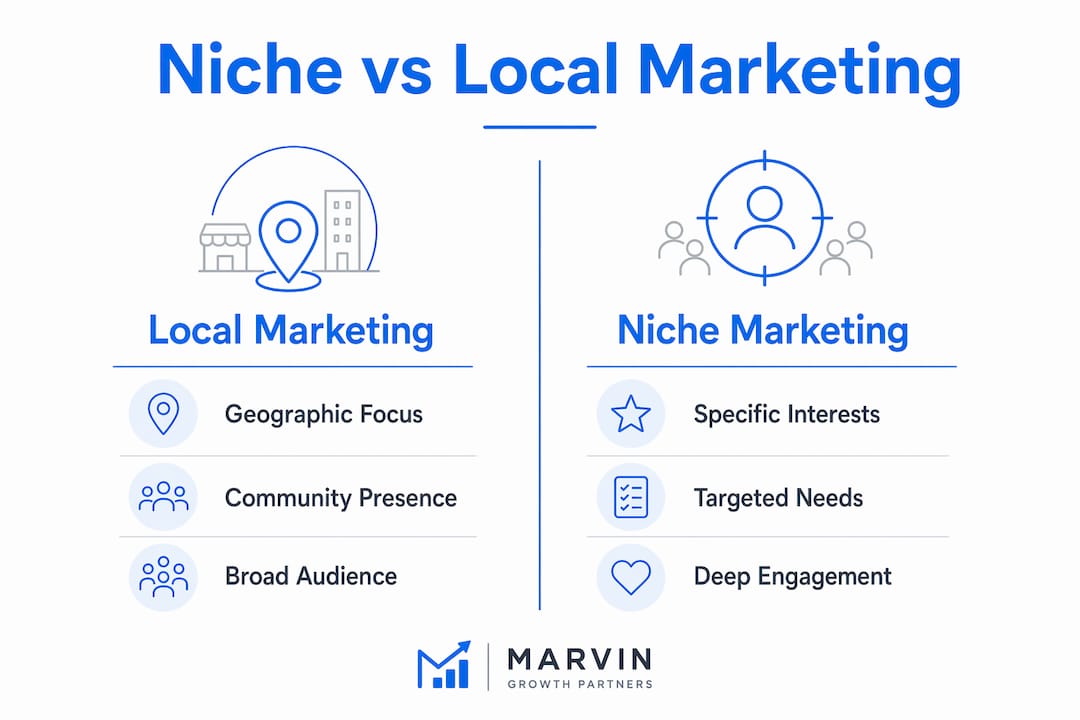
Local marketing focuses on geographic areas, while niche marketing targets groups by shared interests or needs. A bakery advertising to everyone within five miles is doing local marketing. A bakery advertising to gluten-free families within five miles is doing both. The combination is where local entrepreneurs find the most traction.
| Dimension | Local marketing | Niche marketing |
|---|---|---|
| Primary focus | Geographic area | Specific customer need or identity |
| Message type | Broad community appeal | Targeted to shared pain points |
| Competition level | High within the area | Lower within the defined segment |
| Best used for | Awareness and foot traffic | Conversion and loyalty |
| Combined effect | Reaches the right place | Reaches the right person in that place |
The most effective local business marketing combines both layers. You show up in local search results and community channels, but your message speaks to a specific segment of that local population. A yoga studio that markets to “new moms in [neighborhood]” uses local targeting to reach the right geography and niche targeting to reach the right person within it. That double filter produces far better results than either approach alone.
Local SEO for entrepreneurs amplifies this combination by making your niche-specific content discoverable to the exact people searching for it in your area. When someone searches “gluten-free birthday cakes near me,” a bakery with niche-specific content wins that search over a generic competitor every time.
What are the biggest pitfalls in niche marketing for entrepreneurs?
The most common mistake is what practitioners call the “FOMO trap.” Entrepreneurs fear that choosing a narrow audience means losing potential customers. Choosing too broad a market dilutes your message and puts you in price competition with everyone. Niching down actually reduces competition and allows you to charge more. Fear of a small audience is almost always unfounded.
The second major pitfall is skipping validation. Many entrepreneurs commit to a niche based on passion or assumption rather than evidence. Validating economic viability before full commitment prevents wasted effort. Testing methods include pre-sales, landing page sign-ups, and small paid ad campaigns. If real people will not pay for your solution before you build it out, the niche is either too small or poorly defined.
Here is a practical sequence for avoiding the most common mistakes:
- Define the niche with specificity. Name the customer, their problem, and the context. “Women over 50 managing joint pain who want low-impact fitness” is a niche. “People who want to get fit” is not.
- Test before you invest. Run a landing page or a small ad campaign before building out full offerings. Real sign-ups and purchases confirm demand.
- Start hyper-specific, then expand. Entrepreneurs can nest niches by gaining dominance in a tight segment first, then moving into adjacent markets once cash flow and reputation are established.
- Refine continuously. Niche dominance requires ongoing adaptation by updating products and messaging as competitors enter the space. The businesses that stay dominant are the ones that keep narrowing their focus rather than broadening it.
Pro Tip: If a competitor enters your niche, resist the urge to broaden your appeal. Niche down further instead. Becoming the most specialized option in a shrinking segment is often more profitable than trying to out-market a well-funded rival.
Key Takeaways
Niche marketing gives local entrepreneurs a direct path to higher margins, stronger customer loyalty, and lower marketing costs by focusing every resource on a well-defined audience.
| Point | Details |
|---|---|
| Higher engagement from focus | Niche-targeted messaging produces 30% higher engagement than broad content. |
| Lower costs, better ROI | Defined audiences reduce wasted ad spend and raise conversion rates for small budgets. |
| Premium pricing power | Specialist positioning lets you charge more because customers value tailored solutions. |
| Loyalty through relevance | Customers who feel understood return repeatedly and refer others who match their profile. |
| Validate before you commit | Test niche demand with pre-sales or ad tests before building out full offerings. |
The uncomfortable truth about “reaching more people”
I have worked with enough local entrepreneurs to know that the instinct to cast a wide net feels safe. It is not. Every time a business tries to appeal to everyone, it ends up resonating with no one. The messaging gets vague, the ads get expensive, and the customers who do convert are often the wrong fit.
The entrepreneurs I have seen grow fastest are the ones who got specific early and stayed specific longer than felt comfortable. One client ran a fitness studio and was convinced she needed to market to “everyone in the neighborhood.” We narrowed her focus to postpartum women returning to exercise. Her class fill rate went from inconsistent to fully booked within two months. She did not lose customers by niching. She stopped attracting the wrong ones.
The fear of limiting your audience is real, but it is almost always wrong. A smaller, more defined audience means your marketing budget goes further, your message lands harder, and your customers become advocates rather than one-time buyers. Starting narrow and building a custom marketing strategy around a specific segment is not a constraint. It is the fastest path to owning a market.
— Eric
How Marvingrowthpartners helps local entrepreneurs go deeper
Local entrepreneurs who know their niche still need a system to reach it consistently and convert interest into revenue.

Marvingrowthpartners works with local business owners to build growth strategies that align niche positioning with real execution. That means defining your audience with precision, building messaging that converts, and allocating your budget where it produces measurable returns. The work is not theoretical. It is built around the specific growth stage and cash flow reality of your business. If you are ready to stop marketing to everyone and start winning with the right customers, see our approach to find out how we build that system with you.
FAQ
What is niche marketing for small businesses?
Niche marketing is the practice of targeting a specific, well-defined customer group rather than a broad general audience. Small businesses use it to reduce competition, lower marketing costs, and build stronger customer relationships.
How does niche marketing increase sales for local entrepreneurs?
Focused messaging reaches people who are already looking for your specific solution, which raises conversion rates and reduces the cost of acquiring each customer. Niche brands also command premium pricing because customers pay more for tailored solutions.
What is the difference between local marketing and niche marketing?
Local marketing targets customers by geographic area, while niche marketing targets customers by shared needs or interests. Combining both produces the strongest results for local entrepreneurs.
How do I validate a niche before committing my full budget?
Test demand with a landing page, a pre-sale offer, or a small paid ad campaign before investing fully. Real sign-ups and purchases confirm that the niche has economic viability.
Can a niche be too small for a local business?
A niche is too small if it cannot generate enough revenue to sustain the business at your target margins. The fix is usually to expand the geographic reach or add an adjacent customer segment rather than broadening the niche definition itself.
Recommended
- Why Local SEO Matters for Entrepreneurs in 2026 – Marvin Growth Partners
- Best Social Media Platforms for Local Entrepreneurs – Marvin Growth Partners
- Low-Cost Local Marketing Tactics for SMBs in 2026 – Marvin Growth Partners
- Ecommerce Marketing Strategy 2026: The Niche Retailer’s Blueprint for – Marvin Growth Partners