

The Role of Marketing Execution Planning for SMBs
Marketing execution planning is the systematic process of turning a marketing strategy into coordinated, operational tasks that deliver measurable business outcomes. The role of marketing execution planning goes far beyond scheduling posts or assigning tasks. It defines who owns what, when reviews happen, and how campaigns move from brief to launch without losing momentum. For small and medium-sized enterprises, treating this discipline seriously is the difference between a strategy that looks good on paper and one that actually drives revenue.
What is the role of marketing execution planning?
Marketing execution planning is the operational layer that sits between strategy and results. Execution is where commercial value is created or lost, and failures typically stem from poor execution despite a strong strategy. That insight reframes the entire conversation. The problem is rarely the strategy itself. The problem is the gap between deciding what to do and actually doing it well.

The industry term for this discipline is marketing operations planning, though “execution planning” has become the widely used shorthand among practitioners. Both terms describe the same function: converting strategic marketing objectives into repeatable, accountable workflows.
For SMBs, this matters more than it does for large enterprises. You do not have a 40-person marketing department to absorb inefficiency. Every wasted sprint, every missed deadline, and every campaign launched without a clear brief costs you real money and real time.
A well-built execution plan produces four core artifacts:
- A prioritized work backlog with clear deliverables
- A content and campaign calendar with ownership assigned
- A review cadence with defined checkpoints
- A measurement framework tied directly to business goals
These are not bureaucratic documents. They are the infrastructure that keeps your marketing moving in the right direction.
How does execution planning connect strategy to daily workflows?
The operating cadence for marketing teams follows weekly cycles for shipping updates, biweekly campaign adjustments, and monthly strategic alignment reviews. That three-tier rhythm is not arbitrary. It matches the natural pace of marketing work: fast enough to stay current, structured enough to catch drift before it compounds.
Weekly cycles handle the tactical layer. Content goes live, ads get checked, copy gets approved. Biweekly iterations address performance signals. Did the campaign hit its click-through rate target? Does the messaging need adjustment? Monthly reviews zoom out to ask whether the overall strategy still fits the business context.
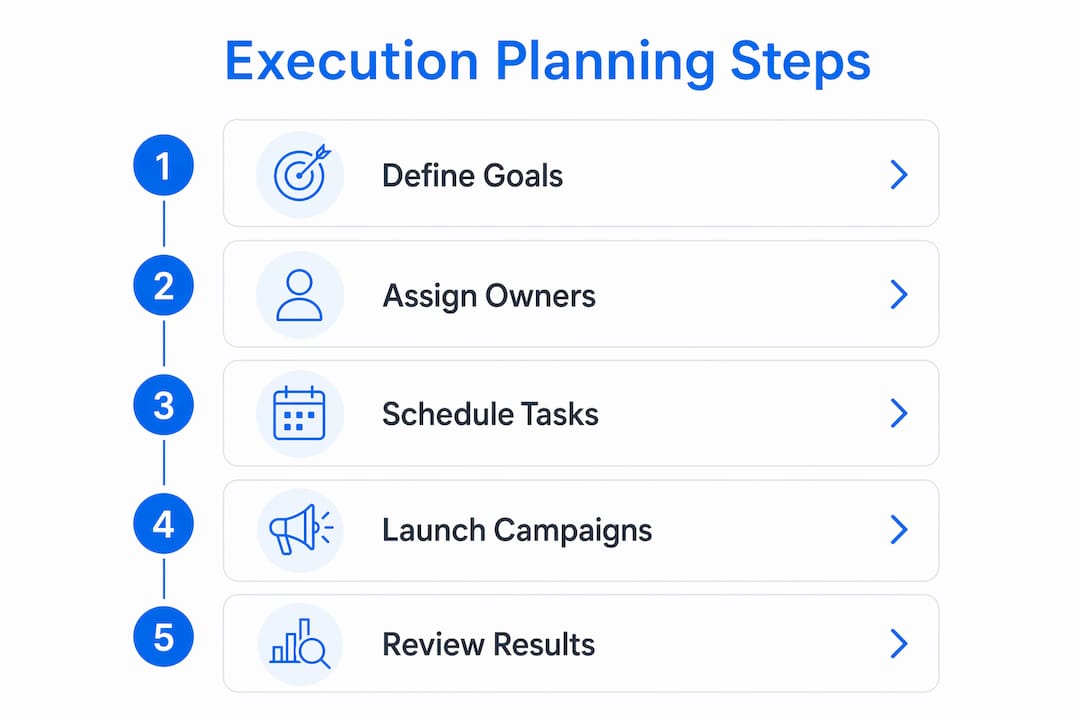
Clear ownership over messaging, content, paid media, and analytics prevents work from falling through the cracks. Every deliverable needs a named owner, not a team. “Marketing will handle it” is how campaigns stall. “Sarah owns the email sequence, and James owns the paid ads” is how campaigns ship.
Pro Tip: Build your ownership map before you build your calendar. If you cannot name one person accountable for each deliverable, the plan is not ready to execute.
The execution plan also defines what integrated marketing strategy looks like in practice. It connects the channel-level work back to the central strategic goal, so every piece of content and every ad dollar points in the same direction.
Why does marketing execution break down?
Most execution failures share a common root: planning and execution are treated as separate stages. Strategy gets handed off to a team that was not involved in building it. The brief is vague. Approvals are informal. Launch happens without a checklist. Then the post-campaign review never happens because everyone moved on.
Execution must be treated as an operational stack, not a linear workflow. That means layering intake quality, approval workflows, launch controls, and optimization loops on top of each other. Remove any one layer and the whole system becomes fragile.
The most common breakdowns in SMB marketing execution include:
- Vague briefs: Campaigns launch without a clear audience, message, or success metric.
- Informal approvals: Work gets published before the right people have reviewed it.
- No feedback loops: Campaigns run to completion without mid-flight adjustments.
- Diffuse ownership: Multiple people think someone else is responsible for a deliverable.
- Disconnected data: Performance metrics live in separate tools and never inform the next campaign.
Launch controls and approval discipline are not bureaucratic overhead. They are the infrastructure that separates marketing teams that learn from every campaign from teams that repeat the same mistakes at scale.
Execution planning designed throughout the strategy process prevents these breakdowns. When the team that builds the strategy also maps the execution workflow, the brief is tighter, the handoffs are cleaner, and the launch is less likely to go sideways.
Best practices for managing execution plans in SMBs
The most effective organizations centralize goals, timelines, and performance data into a single living system. That eliminates the disconnected tracking that burns budget and creates confusion. One source of truth means everyone sees the same priorities, the same deadlines, and the same results.
A living marketing plan is not a static document. Marketing plans that function as living systems and integrate collaboration and data drive better execution results than plans that get written in January and reviewed in December. The plan should update as the business changes, as campaigns produce data, and as priorities shift.
The table below shows how execution planning elements map to the three-tier review cadence:
| Execution element | Weekly | Biweekly | Monthly |
|---|---|---|---|
| Content publishing | Ship and check | Adjust based on engagement | Audit against strategy |
| Paid media | Monitor spend and CTR | Optimize targeting and creative | Review CAC and pipeline contribution |
| Ownership review | Confirm task status | Resolve blockers | Reassign if needed |
| KPI tracking | Log leading indicators | Assess conversion trends | Report on business impact |
Aligning campaigns with core business goals is the non-negotiable foundation of this system. Without that alignment, you can execute flawlessly and still produce work that does not move the business forward.
Pro Tip: Treat your execution plan as a product, not a project. It needs an owner, a version history, and a regular release cycle. If no one is responsible for keeping the plan current, it will drift into irrelevance within 60 days.
Execution leadership means one person is accountable for the full chain from brief to post-campaign review. That is not a task manager. That is a senior marketing operator with the authority to make decisions, resolve blockers, and hold the team to the plan.
How do you measure marketing execution success?
Well-defined KPIs linked directly to business goals, alongside leading indicators like CTR and conversion rates, create an effective measurement spine. That spine drives every decision in the execution cycle. Without it, you are reacting to noise instead of responding to signal.
The measurement process follows four steps:
- Define the KPIs before launch. Customer acquisition cost (CAC), qualified pipeline, CTR, and revenue contribution are the core metrics for most SMBs. Set the target before the campaign runs.
- Track leading indicators weekly. CTR and engagement rates tell you early whether the campaign is working. Do not wait for the final report.
- Run a structured mid-flight review. At the biweekly checkpoint, compare actual performance against the target. Adjust creative, targeting, or spend based on data.
- Conduct a post-campaign debrief. Document what worked, what did not, and what changes the next execution cycle should incorporate.
Speed without feedback loops is ineffective. The cadence of reviews matters as much as launch speed. A team that ships fast but never reviews results will repeat the same mistakes at increasing cost.
Data-driven marketing decisions close the loop between execution and strategy. When performance data flows back into the planning process, the next campaign starts from a stronger position than the last.
Key Takeaways
Effective marketing execution planning requires a living system with clear ownership, a structured review cadence, and KPIs tied directly to business goals.
| Point | Details |
|---|---|
| Execution planning bridges strategy and results | It converts strategic goals into operational workflows with named owners and defined timelines. |
| Three-tier cadence drives consistency | Weekly, biweekly, and monthly review cycles keep execution aligned with strategy without slowing delivery. |
| Ownership prevents work from stalling | Every deliverable needs one named owner, not a team, to move from brief to launch. |
| Living plans outperform static documents | Plans that update with business data and campaign results produce better execution outcomes over time. |
| Measurement spines guide decisions | KPIs like CAC, CTR, and qualified pipeline must be set before launch and reviewed at every cadence checkpoint. |
Why execution planning is the most underrated discipline in SMB marketing
Most SMBs I work with have a strategy. They have a brand story, a target market, and a set of channels they want to use. What they rarely have is a system for executing that strategy consistently. The strategy sits in a deck. The execution lives in someone’s inbox.
The mistake I see most often is treating execution planning as an administrative task rather than a strategic one. Teams spend weeks refining the strategy and then hand it off with a vague brief and a deadline. That is where the value disappears. The brief is the strategy in operational form. If it is weak, the campaign will be weak, regardless of how good the thinking was upstream.
The other pattern I see is confusing activity with execution. Publishing content, running ads, and sending emails are activities. Execution is the system that ensures those activities are the right ones, done at the right time, measured against the right outcomes, and improved with every cycle. Without that system, you are busy but not effective.
The SMBs that get this right treat execution planning as infrastructure. They build it once, maintain it continuously, and use it to make every campaign smarter than the last. That is not a large-team advantage. It is a discipline advantage. Any SMB can build it.
— Eric
How Marvingrowthpartners helps SMBs build execution systems that work
Marvingrowthpartners specializes in aligning executive-level strategy with hands-on execution for growing businesses. If your marketing feels disconnected from your business goals, or if campaigns launch without clear ownership and measurement, that is exactly the gap Marvingrowthpartners is built to close.

The team at Marvingrowthpartners builds tailored execution frameworks based on the real challenges your business faces, including cash flow constraints, growth stage transitions, and team capacity limits. The result is a growth strategy and execution plan that produces measurable ROI without the overhead of a full-time internal marketing team. If you want execution that actually moves the needle, Marvingrowthpartners delivers the structure to make it happen.
FAQ
What is marketing execution planning?
Marketing execution planning is the process of converting a marketing strategy into operational workflows, ownership assignments, and review cadences that ensure campaigns deliver measurable business outcomes. It is the system that connects strategic goals to daily marketing work.
Why does marketing execution fail in SMBs?
Execution fails most often because planning and execution are treated as separate stages, briefs are vague, and no single person owns the full chain from brief to post-campaign review. Structured intake, approval discipline, and feedback loops prevent these breakdowns.
What KPIs should SMBs track for marketing execution?
The core KPIs for SMB marketing execution are customer acquisition cost (CAC), qualified pipeline, click-through rate (CTR), and revenue contribution. Leading indicators like CTR should be tracked weekly, while business-impact metrics are reviewed monthly.
How often should SMBs review their marketing execution plan?
SMBs should follow a three-tier cadence: weekly for task delivery and leading indicators, biweekly for campaign adjustments, and monthly for strategic alignment. This rhythm keeps execution current without creating review fatigue.
What is a living marketing plan?
A living marketing plan is an execution document that updates continuously as the business changes, campaigns produce data, and priorities shift. Static annual plans lose relevance quickly. Living plans integrate collaboration and performance data to drive better results over time.
Recommended
- Build a Custom Marketing Strategy for Your SMB in 2026 – Marvin Growth Partners
- Marketing Strategy Types for SMBs: 2026 Growth Guide – Marvin Growth Partners
- Why SMBs Need Personalized Marketing to Grow – Marvin Growth Partners
- Why Bootstrapped Marketing Strategies Work for SMBs – Marvin Growth Partners